
As a new player to the format, is there any like team style that would be better for someone learning the format? Used to play competitively awhile ago during Gen 7 and that OU and Ubers. Big reason I wanted to try out the format was cause of some of those older Ubers being viable lol.

-
Smogon Premier League is here and the team collection is now available. Support your team!
-
Welcome to Smogon! Take a moment to read the Introduction to Smogon for a run-down on everything Smogon, and make sure you take some time to read the global rules.
You are using an out of date browser. It may not display this or other websites correctly.
You should upgrade or use an alternative browser.
You should upgrade or use an alternative browser.
Metagame SV Ubers UU Metagame Discussion (Giratina Ban @ Post 739)
- Thread starter KineSquared
- Start date

While there is no immediate consensus to which team style is best due to how big of a change losing Giratina is, predictions from the most knowledgeable members of our tier suggest that Hyper Offense will be very good, while Stall and Balance are not good. Jury is still out on weather, but its thought that rain may have a chance to be good again, while the other weathers are still not good.As a new player to the format, is there any like team style that would be better for someone learning the format? Used to play competitively awhile ago during Gen 7 and that OU and Ubers. Big reason I wanted to try out the format was cause of some of those older Ubers being viable lol.
Makes sense, I figured weather wouldn’t be great cause all the weather setters usually associated with ubers aren’t in Ubers UU. Hyper offense sounds fun to me though, I think in gen 7 I used mega diancie rocks HO lol.While there is no immediate consensus to which team style is best due to how big of a change losing Giratina is, predictions from the most knowledgeable members of our tier suggest that Hyper Offense will be very good, while Stall and Balance are not good. Jury is still out on weather, but its thought that rain may have a chance to be good again, while the other weathers are still not good.


Seasonal Stats! Apologies for the wait, obviously this is out of date but want it out here regardless.
Partners and Moves | Combos | Leads
USAGE
Even if its outdated, a snapshot of the meta leading up to this UMPL and UMFL is always nice to look back on. Heres to the tier with Giratina, and praying we get it back again soon!
PLEASE NOTE THAT SINCE THESE STATS BEGAN BEING TRACKED:
Giratina, Regieleki, Grimmsnarl, Terapagos, Ditto, and Spectrier are NO LONGER in the tier.
Partners and Moves | Combos | Leads
USAGE
Code:
+ ---- + ------------------ + ---- + ------- + ------- +
| Rank | Pokemon            | Use  | Usage % |  Win %  |
+ ---- + ------------------ + ---- + ------- + ------- +
| 1    | Mewtwo             |  242 |  43.21% |  50.41% |
| 2    | Giratina           |  218 |  38.93% |  51.83% |
| 3    | Roaring Moon       |  195 |  34.82% |  50.77% |
| 4    | Magearna           |  193 |  34.46% |  52.33% |
| 5    | Arceus-Poison      |  184 |  32.86% |  48.91% |
| 6    | Landorus           |  159 |  28.39% |  50.94% |
| 7    | Samurott-Hisui     |  155 |  27.68% |  51.61% |
| 8    | Dragonite          |  122 |  21.79% |  54.92% |
| 9    | Arceus-Electric    |  115 |  20.54% |  53.04% |
| 10   | Arceus-Ice         |  111 |  19.82% |  51.35% |
| 11   | Deoxys             |   87 |  15.54% |  48.28% |
| 12   | Spectrier          |   85 |  15.18% |  47.06% |
| 13   | Urshifu            |   74 |  13.21% |  41.89% |
| 14   | Gholdengo          |   71 |  12.68% |  60.56% |
| 14   | Gouging Fire       |   71 |  12.68% |  50.70% |
| 16   | Araquanid          |   70 |  12.50% |  50.00% |
| 17   | Palafin            |   67 |  11.96% |  58.21% |
| 18   | Terapagos          |   61 |  10.89% |  52.46% |
| 19   | Arceus-Dark        |   60 |  10.71% |  50.00% |
| 20   | Kyurem-White       |   53 |   9.46% |  45.28% |
| 21   | Cyclizar           |   51 |   9.11% |  45.10% |
| 22   | Mimikyu            |   49 |   8.75% |  44.90% |
| 23   | Chi-Yu             |   44 |   7.86% |  52.27% |
| 24   | Garganacl          |   42 |   7.50% |  54.76% |
| 25   | Great Tusk         |   30 |   5.36% |  50.00% |
| 26   | Smeargle           |   29 |   5.18% |  55.17% |
| 26   | Arceus-Rock        |   29 |   5.18% |  48.28% |
| 28   | Scizor             |   27 |   4.82% |  55.56% |
| 29   | Palkia-Origin      |   26 |   4.64% |  57.69% |
| 30   | Mandibuzz          |   25 |   4.46% |  44.00% |
| 31   | Annihilape         |   24 |   4.29% |  29.17% |
| 32   | Sneasler           |   23 |   4.11% |  47.83% |
| 33   | Toxapex            |   21 |   3.75% |  52.38% |
| 33   | Grimmsnarl         |   21 |   3.75% |  42.86% |
| 33   | Latios             |   21 |   3.75% |  33.33% |
| 36   | Ursaluna-Bloodmoon |   20 |   3.57% |  60.00% |
| 36   | Zamazenta-*        |   20 |   3.57% |  55.00% |
| 36   | Blissey            |   20 |   3.57% |  50.00% |
| 39   | Iron Treads        |   19 |   3.39% |  63.16% |
| 39   | Okidogi            |   19 |   3.39% |  47.37% |
| 39   | Ursaluna           |   19 |   3.39% |  42.11% |
| 39   | Lugia              |   19 |   3.39% |  36.84% |
| 39   | Ogerpon-Hearthflame |   19 |   3.39% |  31.58% |
| 44   | Iron Bundle        |   18 |   3.21% |  38.89% |
| 44   | Dragapult          |   18 |   3.21% |  33.33% |
| 46   | Volcarona          |   16 |   2.86% |  43.75% |
| 47   | Solgaleo           |   14 |   2.50% |  42.86% |
| 48   | Alomomola          |   13 |   2.32% |  38.46% |
| 48   | Baxcalibur         |   13 |   2.32% |  38.46% |
| 50   | Corviknight        |   12 |   2.14% |  33.33% |
| 51   | Quagsire           |   11 |   1.96% |  63.64% |
| 51   | Clodsire           |   11 |   1.96% |  36.36% |
| 51   | Palkia             |   11 |   1.96% |  36.36% |
| 51   | Walking Wake       |   11 |   1.96% |  27.27% |
| 55   | Dialga-Origin      |   10 |   1.79% |  70.00% |
| 55   | Ceruledge          |   10 |   1.79% |  60.00% |
| 55   | Torkoal            |   10 |   1.79% |  50.00% |
| 55   | Archaludon         |   10 |   1.79% |  30.00% |
| 59   | Arceus-Bug         |    9 |   1.61% |  55.56% |
| 59   | Arceus-Fighting    |    9 |   1.61% |  33.33% |
| 61   | Regieleki          |    8 |   1.43% |  50.00% |
| 61   | Cloyster           |    8 |   1.43% |  37.50% |
| 63   | Raging Bolt        |    7 |   1.25% |  57.14% |
| 63   | Dialga             |    7 |   1.25% |  57.14% |
| 65   | Gothitelle         |    6 |   1.07% |  66.67% |
| 65   | Espathra           |    6 |   1.07% |  33.33% |
| 65   | Tornadus-Therian   |    6 |   1.07% |  33.33% |
| 68   | Muk-Alola          |    5 |   0.89% |  60.00% |
| 68   | Skarmory           |    5 |   0.89% |  40.00% |
| 70   | Excadrill          |    4 |   0.71% |  75.00% |
| 70   | Tyranitar          |    4 |   0.71% |  75.00% |
| 70   | Rillaboom          |    4 |   0.71% |  50.00% |
| 70   | Enamorus           |    4 |   0.71% |  50.00% |
| 70   | Ninetales          |    4 |   0.71% |   0.00% |
| 75   | Kommo-o            |    3 |   0.54% | 100.00% |
| 75   | Kleavor            |    3 |   0.54% |  66.67% |
| 75   | Iron Valiant       |    3 |   0.54% |  66.67% |
| 75   | Orthworm           |    3 |   0.54% |  66.67% |
| 75   | Pecharunt          |    3 |   0.54% |  66.67% |
| 75   | Ogerpon-Cornerstone |    3 |   0.54% |  33.33% |
| 75   | Scream Tail        |    3 |   0.54% |  33.33% |
| 75   | Ditto              |    3 |   0.54% |  33.33% |
| 83   | Clefable           |    2 |   0.36% | 100.00% |
| 83   | Reshiram           |    2 |   0.36% | 100.00% |
| 83   | Arcanine-Hisui     |    2 |   0.36% | 100.00% |
| 83   | Primarina          |    2 |   0.36% |  50.00% |
| 83   | Moltres            |    2 |   0.36% |  50.00% |
| 83   | Mamoswine          |    2 |   0.36% |  50.00% |
| 83   | Garchomp           |    2 |   0.36% |  50.00% |
| 83   | Arceus-Grass       |    2 |   0.36% |  50.00% |
| 83   | Hattrem            |    2 |   0.36% |  50.00% |
| 83   | Ninetales-Alola    |    2 |   0.36% |   0.00% |
| 83   | Pelipper           |    2 |   0.36% |   0.00% |
| 83   | Hoopa-Unbound      |    2 |   0.36% |   0.00% |
| 95   | Iron Boulder       |    1 |   0.18% | 100.00% |
| 95   | Deoxys-Defense     |    1 |   0.18% | 100.00% |
| 95   | Slowking-Galar     |    1 |   0.18% | 100.00% |
| 95   | Blaziken           |    1 |   0.18% | 100.00% |
| 95   | Weezing-Galar      |    1 |   0.18% | 100.00% |
| 95   | Galvantula         |    1 |   0.18% | 100.00% |
| 95   | Cinderace          |    1 |   0.18% | 100.00% |
| 95   | Cinccino           |    1 |   0.18% | 100.00% |
| 95   | Terrakion          |    1 |   0.18% | 100.00% |
| 95   | Swampert           |    1 |   0.18% |   0.00% |
| 95   | Leavanny           |    1 |   0.18% |   0.00% |
| 95   | Barraskewda        |    1 |   0.18% |   0.00% |
| 95   | Whimsicott         |    1 |   0.18% |   0.00% |
| 95   | Iron Hands         |    1 |   0.18% |   0.00% |
| 95   | Jirachi            |    1 |   0.18% |   0.00% |
| 95   | Gengar             |    1 |   0.18% |   0.00% |
| 95   | Lokix              |    1 |   0.18% |   0.00% |
| 95   | Masquerain         |    1 |   0.18% |   0.00% |
Even if its outdated, a snapshot of the meta leading up to this UMPL and UMFL is always nice to look back on. Heres to the tier with Giratina, and praying we get it back again soon!
PLEASE NOTE THAT SINCE THESE STATS BEGAN BEING TRACKED:
Giratina, Regieleki, Grimmsnarl, Terapagos, Ditto, and Spectrier are NO LONGER in the tier.

The Ubers UU Council is Looking for YOUR Opinion on
ARCEUS-ELECTRIC
Ever since the departure of Giratina shocked the community, we've found that much of the playerbase has been struck by the bolt of lightning known as Arceus-Electric. While it's absolutely been a point of discussion in the past (receiving a 3.7 on the last Giratina-Era survey we put out) it has never been strong enough to justify any action, especially given that it struggled into the ever-present Giratina. Giratina (until its rise mid UMPL) was often able to act as a consistent stop-gap to Arceus-Electric, ensuring that one would have ample time to chip it down and stop Arceus from setting up. With that hurdle eliminated, Arceus-Electric has been given newfound life predominantly through its CM sets. The sheer variety of tera types and the ability to tweak its spreads to allow it to manage offensive threats has turned it into one of the most terrifiying mons to see in preview, knowing that in some cases getting the tera type wrong or simply allowing it to get those crucial setup turns can be game-ending. This doesn't even begin to cover the physical sets (made possible due to the power of Supercell Slam), which are certainly less common but are worthy of being addressed since it adds to the difficulty in managing it correctly both in game and in the builder.
That being said, new checks have started to pop up. The rise in Great Tusk, continued success of Iron Treads, and experimentations into more hazard stack and priority spam has allowed to the UMPL playerbase to somewhat adjust to Arceus's power, with it ultimately having a clean 50% winrate in the whole tournament. Mewtwo is and will continue to be a tool to out-offense the CM sets, and it can be prone to being physically overwhelmed with setup sweepers like the ever-present DD Dragons and Arceus forms, especially when their own tera is able to be thrown into the mix.
The reason we are approaching this as a call for discussion as opposed to a survey is so that we can focus specifically on Arceus Electric, as it was the most unanimously agreed upon factor in the council. This was also something that seemed to be Public Enemy #1 from many UMPL players we have discussed with. While there are other options that could be looked at right now (namely Roaring Moon and Arceus-Ice), it makes more sense to tackle the biggest point of discussion before moving on to the lesser threats, rather then attempting to handle all of them at once. We will likely be posting a survey after UUBPL to get a more in depth community opinion on the state of the meta.
If any action ends up being deemed necessary, rest assured it will happen before UUBPL! We are looking forwards to hearing everyone's thoughts, and congrats again to the Manes on their win!


I'll try and write a longer more in depth post later, but right now it's past 1 am and I have a quiz tomorrow.
Arc Electric is absolutely my biggest road block in the builder, and most of the time I feel like the best way to beat it is with my own arc electric (Im specifically talking about the Calm Mind set, which i think is the stronger one). Even mons like Iron Treads end up becoming Calm Mind fodder after Tera. The secondary issue for me personally is that it's SD and DD sets are perfectly viable. This makes it even harder to consistently beat it since going into the wrong check can lead to you giving your opponent a free turn. Most recently, Taka used a TbFlying Arce to 6-0 Frito in Finals of UMPL, now while that is a specific Tera reliant set, it does showcase the issue I have with Arce. This is worse than something like Rmoon, which gets most of it's variety though Tera, while it's still difficult to deal with, it feels less impossible. Arc Ice is just lower on the chopping block for me personally.
Anyways, this all subject to change. I'm hoping to come back to this at some point with new thoughts and maybe some replays, but for an initial post I think this is fine. Anyways, meta is better with Tina gone and I would be happy to see it stay that way :D
Arc Electric is absolutely my biggest road block in the builder, and most of the time I feel like the best way to beat it is with my own arc electric (Im specifically talking about the Calm Mind set, which i think is the stronger one). Even mons like Iron Treads end up becoming Calm Mind fodder after Tera. The secondary issue for me personally is that it's SD and DD sets are perfectly viable. This makes it even harder to consistently beat it since going into the wrong check can lead to you giving your opponent a free turn. Most recently, Taka used a TbFlying Arce to 6-0 Frito in Finals of UMPL, now while that is a specific Tera reliant set, it does showcase the issue I have with Arce. This is worse than something like Rmoon, which gets most of it's variety though Tera, while it's still difficult to deal with, it feels less impossible. Arc Ice is just lower on the chopping block for me personally.
Anyways, this all subject to change. I'm hoping to come back to this at some point with new thoughts and maybe some replays, but for an initial post I think this is fine. Anyways, meta is better with Tina gone and I would be happy to see it stay that way :D


In my opinion Arc Elec is one of those mons who has multiple sets and are all good. It can be a guessing game on whenever it's physical or special. It can be sd extrem killer, dd, cm sweeper which is a lot of sets to account for espacially since cm and physical sets have vastly different checks. All these sets can end game very quickly are makes Arceus elec one of the most feared sweepers for a reson.
With that being said I don't support tiering action on it yet. I think even tho there is a guessing game on the physical or special set you can most of the time guess by the look of their team. You cab be wrong ofc but I see it a bit like the zard x vs y debate. To add to it I think that there are some good checks to it. For sd and dd sets a good dragon type with some bulk can beat it. I can think of stuff like Gouging Fire, Dialga forms. Ground types have resurged in popularity despite no Lando-T and Gliscor with scarf Great Tusk which is a great rk, threads which can help pivot around it, Lando-I who can force a tera on physical sets. The extrem killer arceus is one of the many this tier had and I don't think is broken at all. The dd set can be good and we saw the tera blast flying set to snipe tusk but I personally need to see more. The cm set is more tricky but I think stuff like phazing with hazards espacially hazard stack which is really good makes it punishing. We can also add that this set needs to be scared of going for the cm war against opposing Arceus. It will also struggle into stuff like stall with Clod. Mewtwo, a top 2 mon in the meta in my opinion can out offense it hard and runs boots most of the time so it isn't scared about Arceus Elec on webs.
If it was this and Arceus brought nothing defensivly I wouldn't mind it going. However I did find it usefull defensivly with it being able to sponge twaves notably from magerna. It's also a check to Lugia who I think would become even better with it left.
I'm open to hear more about it from fellow players as my opinion can of course change with some good arguments
With that being said I don't support tiering action on it yet. I think even tho there is a guessing game on the physical or special set you can most of the time guess by the look of their team. You cab be wrong ofc but I see it a bit like the zard x vs y debate. To add to it I think that there are some good checks to it. For sd and dd sets a good dragon type with some bulk can beat it. I can think of stuff like Gouging Fire, Dialga forms. Ground types have resurged in popularity despite no Lando-T and Gliscor with scarf Great Tusk which is a great rk, threads which can help pivot around it, Lando-I who can force a tera on physical sets. The extrem killer arceus is one of the many this tier had and I don't think is broken at all. The dd set can be good and we saw the tera blast flying set to snipe tusk but I personally need to see more. The cm set is more tricky but I think stuff like phazing with hazards espacially hazard stack which is really good makes it punishing. We can also add that this set needs to be scared of going for the cm war against opposing Arceus. It will also struggle into stuff like stall with Clod. Mewtwo, a top 2 mon in the meta in my opinion can out offense it hard and runs boots most of the time so it isn't scared about Arceus Elec on webs.
If it was this and Arceus brought nothing defensivly I wouldn't mind it going. However I did find it usefull defensivly with it being able to sponge twaves notably from magerna. It's also a check to Lugia who I think would become even better with it left.
I'm open to hear more about it from fellow players as my opinion can of course change with some good arguments


I think Arceus-Electric's set variety is too much for the tier. Just at a base level, I think this pokemon's Calm Mind is pretty unbearable for this tier. Calm Mind's counterplay generally boils down to other Arceus formes (with Tera Ground or phazing) setting up first, Iron Treads, Clodsire, Mewtwo, and revenge killers. Its standard Tera types in Water or Flying are already incredibly synergistic due to how the only counterplay post Tera is often opposing Arceus-Electric itself. Mewtwo can win if bulky Calm Mind, but generally does end up losing since it cannot pivot in.
Generally, with the offensive tools we have in this tier, I think you can check a lot of pokemon off of keeping momentum and not giving mons free setup turns. A lot of the other offensive tools are frail and can be forced out by speed control or priority. Arceus' natural bulk makes it difficult to end up. A lot of super effective hits bounce off, and even the few revenge killers that actually threaten it out like Great Tusk or Scarf Lando are fodder to common Tera types. Mewtwo is strong but to immediately threaten Arceus out, you need quite a bit of invest and even LO against HP-invested Arceus formes. This isn't even to speak of SpAtk invested Arceus formes that can bruteforce through Mewtwo and Iron Treads, along with coverage that people have not experimented with heavily like Hydro Pump / Draco Meteor / Fire Blast / Agility.
For an example, I'll use two games I played this UMPL where CM Arceus-Electric won despite relatively strong counterplay on paper, while still pivoting around other Pokemon and using its defensive profile.
https://replay.pokemonshowdown.com/smogtours-gen9ubersuu-878335 - this game was me vs Lana, pretty normal structure with speed control in Deoxys / Urshifu-R, a Dragon in Kyurem, DD Arceus-Poison. Yes, Arceus-Poison does go down early which was a misplay on her end. but there are not many Pokemon that can handle Arceus-Electric in general in this tier. If Urshifu were non Scarf and Tusk were Scarfed, Arceus would likely still be able to bruteforce through with Tera. Arceus essentially plays 1v5 with a standard set, forcing opposing Tera (and getting confused -> taking a super effective Earthquake and living only to continue setting up and progressing).
https://replay.pokemonshowdown.com/smogtours-gen9ubersuu-880119 - on paper Arceus-Electric has sufficient counterplay. it could be whatever Ape set, but double Ground + Palk-O + Iceceus should be enough. It ends up being double ground + scarf ape with encore. I think some play could've caught me off guard here with Encoring on recover turns more aggressively, but Arceus-Electric doesn't just setup to win this game. I use it to check Palkia-O and Magearna long term, it kills an Arceus-Ice through speed tie war (though misplay from his end regardless to run that line), forces Lando to tera, and doesn't end up dead after checking all 6 mons all game while making a lot of progress.
Yes, Arceus-Electric contributes a lot defensively to the tier by checking everything. But that defensive capability is so good that it easily gets opportunities to recover momentum on nearly every defensive Pokemon on the tier off of base typing. The only cores that consistently force it out are Iron Treads / Scarf Tusk + Dialga / Arceus-Electric, and these cores are very suspectible to other common breakers such as Mewtwo / Deoxys (who I believe both contribute more defensively to this tier than Arc-Elec) and can be difficult to play around.
I think for a tier of Ubers UU power level, that Pokemon is still somewhat reasonable to check due to how strong opposing Arceus formes, Mewtwo, Deoxys, and Dialga are. But unlike the other Arceus formes, Arceus-Electric not only has a meta defining special set but a reasonably difficult to deal with physical one. A lot of the common physical setup mons / breakers are suspectible to priority or just lose to common defensive tools in this tier like Great Tusk / Mandibuzz / Choice Scarfer / Deoxys / Palafin / phazing Arceus formes / Gouging Fire.
I will be using my finals game for this one but I was using a weird DD Arceus-Electric set that beats the aforementioned list of counterplay almost perfectly (albeit some Tera mons can get annoying like Mandi): https://replay.pokemonshowdown.com/smogtours-gen9ubersuu-889254
 Arceus-Electric @ Zap Plate
Ability: Multitype
Tera Type: Flying
EVs: 252 Atk / 4 Def / 252 Spe
Adamant Nature
- Dragon Dance
- Earthquake
- Supercell Slam
- Tera Blast
I'd say Frito's team was quite good and had adequate counterplay to Arceus-Electric sets. I wasn't going crazy with this set imo, Arceus-Electric just naturally loves Tera Flying and Tera Fly Blast covers all the grounds / grasses that typically check it.
The Scarfers that revenge CM Arc-Elec like Tusk / speed booster Treads / Urshifu / Roaring Moon can pretty much not do enough damage to take out Arceus due to the raw bulk and Tera Fly. Earthquake slams Treads, Gouging Fire, and opposing Arceus-Electric. Since Frito's Arceus took very minimal chip on lead, it was pretty reasonable that Arceus could just win from this point. Arceus in general has a lot more flexibility due to its stats to do whatever it wants.
Generally, other Arceus formes have some great drawback in that Bug is shit, Dark has to get past Scarf Tusk + Magearna alongside not having a strong STAB move for physical sets, Fighting is mid in the double broken psychic tier, Grass is not a particularly good defensive typing into the other arceus formes like ice, poison, and even to an extent vs elec itself, Ice has a glaring rocks weakness in a tier with bad removal alongside no STAB for a physical set, Poison has to contend with the psychics and large number of grounds while its Calm Mind is significantly worse than other arceus formes due to the natural typing and reliance on coverage, Psychic can face competition from the other psychic types and is still onenote special attacking or cpbp, and Rock has some flexibility but ultimately struggles due to its natural typing even if the offensive coverage is excellent and can be either physical or special (rock is a little broken tho lowkey.).
Arceus-Electric has none of these drawbacks, can be physical or special, can fit whatever coverage or tera it wants, doesn't have many Grounds or Pokemon that can truly force it out, and also has an incredibly TWave immunity giving it many more setup opportunities against tier staples. I personally don't agree with Slikkles claims that you can tell on preview. I wouldn't be able to tell on preview on some of my teams if it was SD or DD or CM or support. I don't think most Dragons can take it on in this tier, and I have had Arceus-Electric bruteforce through all of them in various games.
I don't see other Arc formes to be as bad or centralizing. I had extra Tera Grounds / Grasses / Electrics on a lot of my mons in order to not lose to this mon, and I don't think its really feasible to cover this in builder. And like on top of this, this mon is fantastic in Ubers itself... like let bro go
I heavily support tiering action on Arceus-Electric.
Generally, with the offensive tools we have in this tier, I think you can check a lot of pokemon off of keeping momentum and not giving mons free setup turns. A lot of the other offensive tools are frail and can be forced out by speed control or priority. Arceus' natural bulk makes it difficult to end up. A lot of super effective hits bounce off, and even the few revenge killers that actually threaten it out like Great Tusk or Scarf Lando are fodder to common Tera types. Mewtwo is strong but to immediately threaten Arceus out, you need quite a bit of invest and even LO against HP-invested Arceus formes. This isn't even to speak of SpAtk invested Arceus formes that can bruteforce through Mewtwo and Iron Treads, along with coverage that people have not experimented with heavily like Hydro Pump / Draco Meteor / Fire Blast / Agility.
For an example, I'll use two games I played this UMPL where CM Arceus-Electric won despite relatively strong counterplay on paper, while still pivoting around other Pokemon and using its defensive profile.
https://replay.pokemonshowdown.com/smogtours-gen9ubersuu-878335 - this game was me vs Lana, pretty normal structure with speed control in Deoxys / Urshifu-R, a Dragon in Kyurem, DD Arceus-Poison. Yes, Arceus-Poison does go down early which was a misplay on her end. but there are not many Pokemon that can handle Arceus-Electric in general in this tier. If Urshifu were non Scarf and Tusk were Scarfed, Arceus would likely still be able to bruteforce through with Tera. Arceus essentially plays 1v5 with a standard set, forcing opposing Tera (and getting confused -> taking a super effective Earthquake and living only to continue setting up and progressing).
https://replay.pokemonshowdown.com/smogtours-gen9ubersuu-880119 - on paper Arceus-Electric has sufficient counterplay. it could be whatever Ape set, but double Ground + Palk-O + Iceceus should be enough. It ends up being double ground + scarf ape with encore. I think some play could've caught me off guard here with Encoring on recover turns more aggressively, but Arceus-Electric doesn't just setup to win this game. I use it to check Palkia-O and Magearna long term, it kills an Arceus-Ice through speed tie war (though misplay from his end regardless to run that line), forces Lando to tera, and doesn't end up dead after checking all 6 mons all game while making a lot of progress.
Yes, Arceus-Electric contributes a lot defensively to the tier by checking everything. But that defensive capability is so good that it easily gets opportunities to recover momentum on nearly every defensive Pokemon on the tier off of base typing. The only cores that consistently force it out are Iron Treads / Scarf Tusk + Dialga / Arceus-Electric, and these cores are very suspectible to other common breakers such as Mewtwo / Deoxys (who I believe both contribute more defensively to this tier than Arc-Elec) and can be difficult to play around.
I think for a tier of Ubers UU power level, that Pokemon is still somewhat reasonable to check due to how strong opposing Arceus formes, Mewtwo, Deoxys, and Dialga are. But unlike the other Arceus formes, Arceus-Electric not only has a meta defining special set but a reasonably difficult to deal with physical one. A lot of the common physical setup mons / breakers are suspectible to priority or just lose to common defensive tools in this tier like Great Tusk / Mandibuzz / Choice Scarfer / Deoxys / Palafin / phazing Arceus formes / Gouging Fire.
I will be using my finals game for this one but I was using a weird DD Arceus-Electric set that beats the aforementioned list of counterplay almost perfectly (albeit some Tera mons can get annoying like Mandi): https://replay.pokemonshowdown.com/smogtours-gen9ubersuu-889254
Arceus-Electric @ Zap Plate Ability: Multitype
Tera Type: Flying
EVs: 252 Atk / 4 Def / 252 Spe
Adamant Nature
- Dragon Dance
- Earthquake
- Supercell Slam
- Tera Blast
I'd say Frito's team was quite good and had adequate counterplay to Arceus-Electric sets. I wasn't going crazy with this set imo, Arceus-Electric just naturally loves Tera Flying and Tera Fly Blast covers all the grounds / grasses that typically check it.
The Scarfers that revenge CM Arc-Elec like Tusk / speed booster Treads / Urshifu / Roaring Moon can pretty much not do enough damage to take out Arceus due to the raw bulk and Tera Fly. Earthquake slams Treads, Gouging Fire, and opposing Arceus-Electric. Since Frito's Arceus took very minimal chip on lead, it was pretty reasonable that Arceus could just win from this point. Arceus in general has a lot more flexibility due to its stats to do whatever it wants.
Generally, other Arceus formes have some great drawback in that Bug is shit, Dark has to get past Scarf Tusk + Magearna alongside not having a strong STAB move for physical sets, Fighting is mid in the double broken psychic tier, Grass is not a particularly good defensive typing into the other arceus formes like ice, poison, and even to an extent vs elec itself, Ice has a glaring rocks weakness in a tier with bad removal alongside no STAB for a physical set, Poison has to contend with the psychics and large number of grounds while its Calm Mind is significantly worse than other arceus formes due to the natural typing and reliance on coverage, Psychic can face competition from the other psychic types and is still onenote special attacking or cpbp, and Rock has some flexibility but ultimately struggles due to its natural typing even if the offensive coverage is excellent and can be either physical or special (rock is a little broken tho lowkey.).
Arceus-Electric has none of these drawbacks, can be physical or special, can fit whatever coverage or tera it wants, doesn't have many Grounds or Pokemon that can truly force it out, and also has an incredibly TWave immunity giving it many more setup opportunities against tier staples. I personally don't agree with Slikkles claims that you can tell on preview. I wouldn't be able to tell on preview on some of my teams if it was SD or DD or CM or support. I don't think most Dragons can take it on in this tier, and I have had Arceus-Electric bruteforce through all of them in various games.
I don't see other Arc formes to be as bad or centralizing. I had extra Tera Grounds / Grasses / Electrics on a lot of my mons in order to not lose to this mon, and I don't think its really feasible to cover this in builder. And like on top of this, this mon is fantastic in Ubers itself... like let bro go
I heavily support tiering action on Arceus-Electric.
Thank you everyone else for posting so that I did not have to double post! I greatly appreciate having more yappers around :D
Arceus-Elec was something I personally have been concerned with since about the 2nd week of Tina being gone in UMPL, as it because incredibly apparent that Its CM sets have been incredibly difficult to consistently check, causing some of the most siginifacnt warping in the meta I have seen since Zacian was around, with many adaptations being made in the speed control and hazard department to try manage it, sometimes to the detriment of other matchups (I'd argue the rise in ground types and speed control typically good into Arceus Electric is part of what makes Arceus-Ice feel a lot more strong right now). I think that alone is one of the biggest things contributing to my dislike for it in the current meta, but I'll
The tera type versatility in Arceus Electric both across its physical and special sets is a huge factor in making its counterplay feel underwhelming if not irrelevant. Its CM sets are often able to run away with games on their own, and with the defensive benefits that come from tera Fairy, Water, or even picks like Flying give it ways to circumvent would-be answers to it such as the commonly mentioned Great Tusk, Iron Treads, or in general fast attackers Zama, and even the DD Dragons with a boost. As Taka established, the physical sets are likely heavily underexplored as well - I myself have almost ran DD sets considering all of TB Fairy/Ice (ice sucks btw) or Tera Water + Liquidation, as they likely have a lot of merit to them. This of course doesn't even touch on the fact that with the best electric resist in the tier gone, Elec is likely the strongest E-Killer in the format as well due to its lack of a weakness to Mewtwo's psystrike. This is a level of versatility and power that no Arc has seen in recent times due to just how powerful it can be on both sides offensively, where even Poison can struggle with its CM sets due to its middling coverage options. The only place Elec falters is its solo defensive capabilities, but honestly you don't even need it to be defensive when its this damn good at breaking through the tier.
Another thing worth mentioning is how much this has warped both bulky teams and H/O structures alike, with offense's best answer to Arceus Electric often being to try and make sure it can't get that setup turn by out offensing it (which as mentioned can be very hard with tera), or running something like an Arceus Electric themselves. Arceus Electric's viability across all playstyles means that you are reasonably going to have to plan some form of countermeasure to it, and just hope that you aren't relying on your Great Tusk on the inevitable day that someone else choses to bust out TB flying and completely destroy you.
I think there is a world where it is a healthy prescense in this tier, as you can definatley argue that it has been a stifling prescense when it comes to Hyper Offense builds, being one of the better players bulky offense has had to even the playing field in some time. But as I did with Zacian, I think Elec just barely crosses the line on what I'd deem as an acceptable prescense in this tier - realistically not adding many true benefits to the functioning of the metagame. Slikkles mentioned Lugia, but I don't believe that theorymonning like that is a great way to try and justify a mon sticking around, especially when we will still have Arceus Ice and many other tools that can break it down even if they will not do it as easily as Arceus-Electric. As of now I'm likely leaning a ban vote on this one, but will still be happy to hear people out.
Arceus-Elec was something I personally have been concerned with since about the 2nd week of Tina being gone in UMPL, as it because incredibly apparent that Its CM sets have been incredibly difficult to consistently check, causing some of the most siginifacnt warping in the meta I have seen since Zacian was around, with many adaptations being made in the speed control and hazard department to try manage it, sometimes to the detriment of other matchups (I'd argue the rise in ground types and speed control typically good into Arceus Electric is part of what makes Arceus-Ice feel a lot more strong right now). I think that alone is one of the biggest things contributing to my dislike for it in the current meta, but I'll
The tera type versatility in Arceus Electric both across its physical and special sets is a huge factor in making its counterplay feel underwhelming if not irrelevant. Its CM sets are often able to run away with games on their own, and with the defensive benefits that come from tera Fairy, Water, or even picks like Flying give it ways to circumvent would-be answers to it such as the commonly mentioned Great Tusk, Iron Treads, or in general fast attackers Zama, and even the DD Dragons with a boost. As Taka established, the physical sets are likely heavily underexplored as well - I myself have almost ran DD sets considering all of TB Fairy/Ice (ice sucks btw) or Tera Water + Liquidation, as they likely have a lot of merit to them. This of course doesn't even touch on the fact that with the best electric resist in the tier gone, Elec is likely the strongest E-Killer in the format as well due to its lack of a weakness to Mewtwo's psystrike. This is a level of versatility and power that no Arc has seen in recent times due to just how powerful it can be on both sides offensively, where even Poison can struggle with its CM sets due to its middling coverage options. The only place Elec falters is its solo defensive capabilities, but honestly you don't even need it to be defensive when its this damn good at breaking through the tier.
Another thing worth mentioning is how much this has warped both bulky teams and H/O structures alike, with offense's best answer to Arceus Electric often being to try and make sure it can't get that setup turn by out offensing it (which as mentioned can be very hard with tera), or running something like an Arceus Electric themselves. Arceus Electric's viability across all playstyles means that you are reasonably going to have to plan some form of countermeasure to it, and just hope that you aren't relying on your Great Tusk on the inevitable day that someone else choses to bust out TB flying and completely destroy you.
I think there is a world where it is a healthy prescense in this tier, as you can definatley argue that it has been a stifling prescense when it comes to Hyper Offense builds, being one of the better players bulky offense has had to even the playing field in some time. But as I did with Zacian, I think Elec just barely crosses the line on what I'd deem as an acceptable prescense in this tier - realistically not adding many true benefits to the functioning of the metagame. Slikkles mentioned Lugia, but I don't believe that theorymonning like that is a great way to try and justify a mon sticking around, especially when we will still have Arceus Ice and many other tools that can break it down even if they will not do it as easily as Arceus-Electric. As of now I'm likely leaning a ban vote on this one, but will still be happy to hear people out.

In my opinion, Arceus-Electric is one of Ubers UU’s most versatile Pokémon. It has three primary sets: the Calm Mind (CM) set, Dragon Dance (DD) set, and the Swords Dance Extreme Killer (SD Ekiller) set.
Prior to the rise of Giratina, Arceus-Electric was manageable because BO and balance teams had a reliable check to its physical sets in the form of our resident PokéSatan. This meant the biggest threat usually came from special sets, which could be outsped and revenge-killed by Pokémon such as Deoxys, Mewtwo, or even disrupted via Encore from Iron Bundle, assuming you were ballsy enough.
However, with the rise of Tina, most physical sets now have their checks reduced to Great Tusk (and maybe Pecharunt). Here lies the problem: if you predict wrong and it turns out to be a special set, you lose your Ground or physical wall outright. Giratina was much more capable of tanking a stray hit from Arceus-Electric’s special sets, allowing BO and balance teams to scout the set and respond appropriately. With Giratina no longer in the tier, this option is gone, severely hampering BO and balance teams’ ability to manage Arceus-Electric, especially if the player makes even a small mistake, significantly hampering Bulky teams abilities to scout sets.
Furthermore, Tina leaving has made Arceus-Electric’s physical sets far more spammable. It can now comfortably run Supercell Slam, one of SD or DD, and two additional moves tailored to the team’s needs. This often makes an incorrect prediction a near death sentence. Being an Arceus, its natural bulk allows it to set up at least once with ease. Additionally, in its base typing, it is only weak to Ground, so if you know your opponent lacks a Ground-type move, it becomes significantly easier to set up freely (provided the opposing Pokémon lacks disruption or phazing).
Even if you do have a super-effective Ground-type move, this can backfire, as Arceus-Electric can simply Terastallize to remove that weakness. It’s also a safe assumption that if the opponent’s Arceus is at +2, something is going to take serious damage, compounded by the fact that it is likely outspeeding the opposing team at that point if it is a DD set (see Frito vs. Taka finals).
I also agree with our resident yapper Celeste in the sense that the necessity of running an Arceus-Electric check directly contributes to Arceus-Ice becoming much harder to deal with. Ground types, which are otherwise mandatory for Eleceus, now become setup fodder or outright victims for Iceus.
That said, I can understand why Arceus-Electric may not be considered outright broken. There is still reasonable counterplay available. Priority, for example, can significantly hinder DD sets, and Encore disruption can force Arceus-Electric out. This is especially relevant in a hazard-heavy metagame, where repeated forced switches leave it more vulnerable to being worn down and revenge-killed.
Nonetheless, having played PL with Arceus-Electric allowed, as well as a tournament in a no-Arceus-Electric metagame, I can confidently say that a metagame without Arceus-Electric feels far less restrictive in the builder. That said, this may also just be because I am lazy.
Therefore, with respect to the Arceus-Electric suspect, I would like to voice my opinion in favor of a ban, though I remain open to being convinced otherwise and can understand why some may feel that way.
Prior to the rise of Giratina, Arceus-Electric was manageable because BO and balance teams had a reliable check to its physical sets in the form of our resident PokéSatan. This meant the biggest threat usually came from special sets, which could be outsped and revenge-killed by Pokémon such as Deoxys, Mewtwo, or even disrupted via Encore from Iron Bundle, assuming you were ballsy enough.
However, with the rise of Tina, most physical sets now have their checks reduced to Great Tusk (and maybe Pecharunt). Here lies the problem: if you predict wrong and it turns out to be a special set, you lose your Ground or physical wall outright. Giratina was much more capable of tanking a stray hit from Arceus-Electric’s special sets, allowing BO and balance teams to scout the set and respond appropriately. With Giratina no longer in the tier, this option is gone, severely hampering BO and balance teams’ ability to manage Arceus-Electric, especially if the player makes even a small mistake, significantly hampering Bulky teams abilities to scout sets.
Furthermore, Tina leaving has made Arceus-Electric’s physical sets far more spammable. It can now comfortably run Supercell Slam, one of SD or DD, and two additional moves tailored to the team’s needs. This often makes an incorrect prediction a near death sentence. Being an Arceus, its natural bulk allows it to set up at least once with ease. Additionally, in its base typing, it is only weak to Ground, so if you know your opponent lacks a Ground-type move, it becomes significantly easier to set up freely (provided the opposing Pokémon lacks disruption or phazing).
Even if you do have a super-effective Ground-type move, this can backfire, as Arceus-Electric can simply Terastallize to remove that weakness. It’s also a safe assumption that if the opponent’s Arceus is at +2, something is going to take serious damage, compounded by the fact that it is likely outspeeding the opposing team at that point if it is a DD set (see Frito vs. Taka finals).
I also agree with our resident yapper Celeste in the sense that the necessity of running an Arceus-Electric check directly contributes to Arceus-Ice becoming much harder to deal with. Ground types, which are otherwise mandatory for Eleceus, now become setup fodder or outright victims for Iceus.
That said, I can understand why Arceus-Electric may not be considered outright broken. There is still reasonable counterplay available. Priority, for example, can significantly hinder DD sets, and Encore disruption can force Arceus-Electric out. This is especially relevant in a hazard-heavy metagame, where repeated forced switches leave it more vulnerable to being worn down and revenge-killed.
Nonetheless, having played PL with Arceus-Electric allowed, as well as a tournament in a no-Arceus-Electric metagame, I can confidently say that a metagame without Arceus-Electric feels far less restrictive in the builder. That said, this may also just be because I am lazy.
Therefore, with respect to the Arceus-Electric suspect, I would like to voice my opinion in favor of a ban, though I remain open to being convinced otherwise and can understand why some may feel that way.
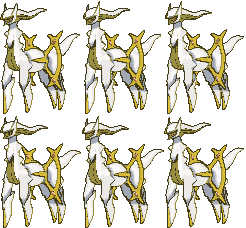
The council has voted to quickban Arceus Electric with a 6-1 supermajority! (5 votes needed to ban)
Tagging Marty and dhelmise to implement!
Votes:
| Celeste | Fishyroads | Frito | Rasche | Shadow079 | Slikkles | Taka |
| BAN | BAN | DNB | BAN | BAN | BAN | BAN |
In the future, we are discussing methods similar to the ongoing Piloswine suspect in NFE that allows participants in recent tours to vote, so please keep an eye out for that if future action is needed! Best of luck in Ubers UU PL everyone!


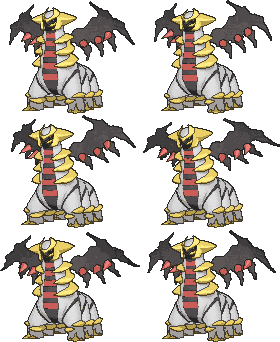
The Ubers UU Council voted to quickban Giratina with a 6-1 supermajority
| Celeste | Fishyroads | Frito | Rasche | Shadow079 | Slikkles | Taka |
| BAN | DNB | BAN | BAN | BAN | BAN | BAN |
Since its rise 3 months ago, the Ubers UU meta has developed at a rapid rate. In its absence, the player base has seen how much of a constraint Giratina exerted both in game and in the team builder. As such, the council voted on whether or not to allow its reintroduction back into the tier. We feel the meta is in a much better state without Giratina's presence, and it will be sent to Ubers UUBL.
tagging Marty and dhelmise to implement! Thank you!!
Let me explain why I voted to ban Giratina:
I believed at the time that Giratina was a necessary evil. It would need multiple mons to deal with it yes but it would also prevent some threats from going crazy. However, needless to say the Giratina metagame was a weird one. It felt very cheesie in terms of playstyles that were used. Giratina forced extreme playstyles to be used to beat it, mostly hyper offense espacially stuff like Ceasless Edge ho as it was one of the best ways to weaken Giratina due to it's huge bulk. Furthermore, Giratina if it ran boots would need to be overwheled to deal with it. This would mean you will prob have to trade at least a mon to weaken it. This kind of playstyle favours ho a lot as it's part of it's structure to work like that, however, this wasn't the case for other playstyles who would rather play a longer game and get some chip which didn't work well due to the huge bulk + wisp.
One of my concerns was that in an non Giratina world hazards would become too powerfull. Turns out Giratina is actually more of a hazard enabler than it prevents them. Yes it has defog but you want to put some moves like wisp + hex or tail and rest with probably sleep talk meaning that you didn't use defog that much. However, when it came to blocking hazards for your team Giratina was a beast. It's basically a better gholdengo as it always beats the spinner while helping beat mid/ long term the defog mons like Corv and Scizor with wisp being a huge pain for these mons and Hex doing a good chunke.
My last point is that even if we expected an ho land with the rise of Giratina to Ubers, it actually didn't and was on the contrary a healthy metagame with a lot of bo and some cool techs and innovation. Giratina made the metagame way more centralized and less balanced in general. For that reason, I voted Ban and we will see on what to do and maybe retest in the future.
I believed at the time that Giratina was a necessary evil. It would need multiple mons to deal with it yes but it would also prevent some threats from going crazy. However, needless to say the Giratina metagame was a weird one. It felt very cheesie in terms of playstyles that were used. Giratina forced extreme playstyles to be used to beat it, mostly hyper offense espacially stuff like Ceasless Edge ho as it was one of the best ways to weaken Giratina due to it's huge bulk. Furthermore, Giratina if it ran boots would need to be overwheled to deal with it. This would mean you will prob have to trade at least a mon to weaken it. This kind of playstyle favours ho a lot as it's part of it's structure to work like that, however, this wasn't the case for other playstyles who would rather play a longer game and get some chip which didn't work well due to the huge bulk + wisp.
One of my concerns was that in an non Giratina world hazards would become too powerfull. Turns out Giratina is actually more of a hazard enabler than it prevents them. Yes it has defog but you want to put some moves like wisp + hex or tail and rest with probably sleep talk meaning that you didn't use defog that much. However, when it came to blocking hazards for your team Giratina was a beast. It's basically a better gholdengo as it always beats the spinner while helping beat mid/ long term the defog mons like Corv and Scizor with wisp being a huge pain for these mons and Hex doing a good chunke.
My last point is that even if we expected an ho land with the rise of Giratina to Ubers, it actually didn't and was on the contrary a healthy metagame with a lot of bo and some cool techs and innovation. Giratina made the metagame way more centralized and less balanced in general. For that reason, I voted Ban and we will see on what to do and maybe retest in the future.
For those of you who recently got into UUbers, I would like to to give a quick run-through what Giratina did and why it was considered vital to the tier function before.
 i: The Tier King
  Giratina until October was arguably the single best pokemon in UUbers, and a near mandatory pick on practically any team that was not Hyper-Offense. Its abiltity to act as simultaneously the best phaser, status debuffer, and tank in the tier while being the best Ghost and Fairy type (through tera) let it have a unique ability to "soft-check" most of the tier, and neglecting to bring it would require one to bring multiple sub-par pokemon to make up for the sheer utility Gira offers, and these teams were practically never seen for a very good reason.
It also had the ability so effectively soft check almost every single common offensive threat in some way due to its huge stat pool and access to both T-Wave and Will-o-Wisp that can cripple most set-up sweepers already, and then phase them out with Dragon Tail or Roar to neuter their boosts. Notably this allowed Giratina to hugely limit the booster energy sweepers in Gouging Fire and Roaring Moon, which often relied on that boost to even have a chance to break through Giratina itself. This meant it was regarded as one of the main things holding Hyper-Offense in check, using its disruptive tools and Rest to be a long-term answer to this brutal playstyle; which notably was the playstyle that lead to the last ban before Giratina left in Spectrier. Sticky Web would also receive one of the highest survey scores in months in the following survey, showing that despite Giratina's prescense Hyper-Offense was clearly still problematic.
Giratina was also a defining aspect of how bulkier playstyles were able to function, as its sheer bulk and ability to ignore status and even stall through pressure lead Giratina to be able to provide consistent counterplay to many defensive threats. This was huge in enabling the success of Bulky-Offense styles, who greatly appreciated Tina's ability to put huge amounts of pressure on many defensive arceus forms, and the experimentation with Alomomola, Pecharunt, and Lugia (to name a few). Even Garganacl was not a consistent answer due to a well played Tina being able to drain it of all its PP through pressure. This isn't to say that balance was unviable, but its viability was clearly stunted when it had to compete with its own best pokemon - let alone the demonic offensive threats that lead it to be mandatory.
 ii: Overcentralization - Is it an Issue?
  Through this depiction of Giratina, I think regardless of your stance on it one thing is clear; Giratina was easily the most overcentralizing Pokemon in the tier. Every teamstyle was dependent on how it could beat Giratina, while somehow managing to survive the offensive onslaught that the tier consisted of. Leading up to October, many of the meta developments made all centered around Giratina and it's role in the tier. Including (but not limited to)
As mentioned, Giratina also hugely impacted the development of balance and bulkier playstyles. While after its ban we saw a meteoric rise of to-be staples such as Pecharunt, Alomomola, or even niche options such as Sinistcha and Clefable, Giratina itself was able to counter many of the potential defensive tools in the tier, which ultimately began to put a strain on balance builders to handle it. Some success was able to be found, with some teams being able to capitalize off of tools like Mandibuzz or Corviknight due to their ability to pivot and posessing decent tools into the rest of the meta. This creates a strange scenario where Giratina was the main thing driving bulkier styles and offense's need to account for it, while simultaneously being the most limiting thing to the overall success of these styles.
So when does this become unhealthy? In my opinion, overcentralization is something that should come to be expected of tiers with this power level, as we've seen consistently in both Ubers and UUbers. But the line should be drawn where something turns from overcentralizing to metagame-warping (in an unhealthy way). I personally see something to meet this criteria when it changes from being a primary threat in the tier that most teams will have to account for in some way (eg, Zamazenta in OU) to whenit forces teams to be largely centered around how to check, and ultimately remove this threat. This was never impossible with Giratina, as it's omniprescense lead many to find ways to effectively pressure it long term. But this can largely be observed through its impact on the teambuilder, where not being effective into Giratina was often a reason to simply not include something, with the upsides having to be huge to even consider.
This ultimately lead me to believe that Giratina met a threshold for being an unhealthily-warping presence in the tier, as the way it warped the metagame was something I deemed harmful in multiple ways.
 iii: The Crimes of Giratina
1. Hazard ControlGiratina does have defog itself, but the issue here is that it almost solely dictated hazard control in the tier. Its existence made rapid spin almost impossible to use (especially after the departure of Terapagos), and with defog being incredibly limited in distribution you weren't seeing it be clicked particularily often. This meant that by virtue of existing, Giratina was able to create an environment where hazards were able to thrive, due to it being the only thing effectively able to remove them. Despite this, it often was not able to because of it's moveslots being in incredibly high demand in an attempt to limit itself from being too passive. This created the perfect storm for hazard stacking to be an incredibly effective playstyle, not just in bulkier teamstyles but in...
 iv: What Gira-Less Taught Us
  To preface, I do not and never have believed in theory and looking at reasons beyond the current meta to make decisions. What I realized over the course of the past 3 months is simply identifiying the issues I had with Giratina when it was present, which I could more easily put into words after seeing what a meta without it looks like. I agree with Slikkles, I happily viewed Giratina as a necessary evil in the tier due to how it functioned as a "glue" despite its flaws, believing it to be the easiest solution to handling the instability that has consistently arisen in UUbers. However, when it was gone (and arc elec likewise) the first thing that I noticed was the stability of the meta, and how so many things that felt like huge flaws from the tina meta seemed to solve themselves. The most shocking development was how much speed control in the tier improved, with Deoxys reaching new heights of viability, and Scarf Great Tusk + Zamazenta. Of course priority got better (and became stronger), but this was largely to be expected.
But I want to continue with that discussion around stability, because in the time I have been playing the tier I don't think there has ever been a time where I haven't felt pressed to encourage for action on something. While I still have my issues with how strong Roaring Moon is for example, I feel that removing Giratina and its centralizing effects left the metagame in a place where finally, if something felt too strong the metagame could adapt to it. Giratina was so overwhelming in shutting down other options that adapting to metagame threats became less focused on managing the threat it self, but determining if an innovation could withstand Giratina at the same time.
It especially illuminated just how many things Gira invalidated to me (I know I keep harping on this point, but I feel its important). The sheer diversity of mons we have seen had me reflect on Gira meta and the pieces that weren't able to be used then, and why. All of it (shockingly) lead back to Giratina, where it recontextualized Giratina not just as the clear staple defensive piece of the tier, but definatively the most warping piece of said tier after Zacian left. The impact it had was not felt in how it neutered offense as the tiers best wall, but in how it made the rest of the tier grapple with ways to manage Giratina itself.
 Conclusion: Banning a Defensive Staple
  This isn't something that happens often. When it comes to offensive threats, it is easy to pick out mons that are too strong, hit too hard, and have no consistent defensive counterplay. We've seen this play out time and time again, but Giratina is clearly not the same. My gut when I think of a "bannable" defensive mon is to think of something that is quite literally unbreakable by the rest of the tier, but Giratina doesn't meet that either. Instead, Giratina's issues as it pertained to the tier consistent of many smaller issues, most notably how it effected the tier around it, not how Giratina itself was over-performing (though perform it did)!
I felt ultimately with how much Giratina warped the tier and indirectly created instability by existing that the direction to take to push for a healthier, more stable, and more competative meta was to ban it. While issues that aren't Giratina do exist, it has become increasingly clear to me that Giratina is the ultimate culprit for what allowed an unstable, unbalanced, and ultimately unenjoyable metagame.
i: The Tier King It also had the ability so effectively soft check almost every single common offensive threat in some way due to its huge stat pool and access to both T-Wave and Will-o-Wisp that can cripple most set-up sweepers already, and then phase them out with Dragon Tail or Roar to neuter their boosts. Notably this allowed Giratina to hugely limit the booster energy sweepers in Gouging Fire and Roaring Moon, which often relied on that boost to even have a chance to break through Giratina itself. This meant it was regarded as one of the main things holding Hyper-Offense in check, using its disruptive tools and Rest to be a long-term answer to this brutal playstyle; which notably was the playstyle that lead to the last ban before Giratina left in Spectrier. Sticky Web would also receive one of the highest survey scores in months in the following survey, showing that despite Giratina's prescense Hyper-Offense was clearly still problematic.
Giratina was also a defining aspect of how bulkier playstyles were able to function, as its sheer bulk and ability to ignore status and even stall through pressure lead Giratina to be able to provide consistent counterplay to many defensive threats. This was huge in enabling the success of Bulky-Offense styles, who greatly appreciated Tina's ability to put huge amounts of pressure on many defensive arceus forms, and the experimentation with Alomomola, Pecharunt, and Lugia (to name a few). Even Garganacl was not a consistent answer due to a well played Tina being able to drain it of all its PP through pressure. This isn't to say that balance was unviable, but its viability was clearly stunted when it had to compete with its own best pokemon - let alone the demonic offensive threats that lead it to be mandatory.
ii: Overcentralization - Is it an Issue? - Scizor

- Scizor was able to be a powerful priority user that preyed on not only tera fairy users aiming to avoid Giratina's Dragon Tail, but to threaten Gira with Knock or Bullet Punch after tera fairy.
- Dragonite

- Dragonite emerged as an incredibly potent anti-offense tool for offense teams of all flavours, namely due to how it could use its versatile toolkit to circumvent opposing threats with E-Speed and check Giratina with super-effective STAB, Lum berry, Encore, Tera fairy, the list goes on.
- Arceus-Ice

- While Arceus-Ice has been known to be strong for some time, after the departure of Zacian Arceus-Ice established itself as one of the best Arceus forms in the tier due to its ability to be one of the best anti-Giratina Pokemon in the tier, while being able to utilize its STAB and tera versatility to threaten almost the entire tier.
As mentioned, Giratina also hugely impacted the development of balance and bulkier playstyles. While after its ban we saw a meteoric rise of to-be staples such as Pecharunt, Alomomola, or even niche options such as Sinistcha and Clefable, Giratina itself was able to counter many of the potential defensive tools in the tier, which ultimately began to put a strain on balance builders to handle it. Some success was able to be found, with some teams being able to capitalize off of tools like Mandibuzz or Corviknight due to their ability to pivot and posessing decent tools into the rest of the meta. This creates a strange scenario where Giratina was the main thing driving bulkier styles and offense's need to account for it, while simultaneously being the most limiting thing to the overall success of these styles.
So when does this become unhealthy? In my opinion, overcentralization is something that should come to be expected of tiers with this power level, as we've seen consistently in both Ubers and UUbers. But the line should be drawn where something turns from overcentralizing to metagame-warping (in an unhealthy way). I personally see something to meet this criteria when it changes from being a primary threat in the tier that most teams will have to account for in some way (eg, Zamazenta in OU) to whenit forces teams to be largely centered around how to check, and ultimately remove this threat. This was never impossible with Giratina, as it's omniprescense lead many to find ways to effectively pressure it long term. But this can largely be observed through its impact on the teambuilder, where not being effective into Giratina was often a reason to simply not include something, with the upsides having to be huge to even consider.
This ultimately lead me to believe that Giratina met a threshold for being an unhealthily-warping presence in the tier, as the way it warped the metagame was something I deemed harmful in multiple ways.
iii: The Crimes of Giratina 1. Hazard Control
2. The Polarization Towards Hyper-Offense
Hyper-Offense hugely benefitted from the lack of hazard control options, leading to spikes offense and sticky webs being contentious points of discussion, especially after the Zacian ban. The difficulty to manage the hazards that gave these teams such an advantage allowed them to flourish, but created a rather noteable issue at the same time, which was the H/O mirror. While these are nothing new, the ways in which teams would adapt in an attempt to manage Giratina through unconventional tera types and moves would often run the risk of leaving them open to opposing hyper offense, leaving many players with a hard decision - answer Giratina effectively, or manage the mirror into H/O? For a while, this was accomplished through Terapagos as a secondary lead/phaser when it was around, but after its departure the balls-to-the-wall offense strategy ended up being the best. Priority became more common then ever before, and investing into the demonic special threats of Arc-Ice and Electric became the norm. Games slowly became decided more and more on matchup, who haad the better teras, who had the movepool alterations that happened to be best, etc. H/O became incredibly inconsistent, but at the same time was significantly more consistent to the majority of the playerbase compared to Balance, which was a brutal and punishing playstyle to adapt.3. Pushing Defensive Counterplay Away
As I have said a few times now, one of the most notable impacts of Giratina was how it was incredibly punishing of many other defensive mons, because they would rarely have the damage or longevity to beat it. Rest sets would be impervious to toxic stall, and anything that could potentially handle it longer term like Magearna or Psychic Noise Lugias would have to carefully manage their PP, where one slip up could be game-losing. This created an environment where many players consistently complained about the difficulty in running Balance and Bulky Offense structures, because in short it WAS difficult. Not impossible at all, but Giratina put such a ridiculous amount of strain on bulky play that few outside of the most commited players were able to get consistent success with the strategy. You could argue that this promotes skillful play and building (which I would agree to), but the prevalence of cheesy and unpredictable hyper-offense didn't just effect mirrors, with how much Bulk had to manage Giratina ON TOP of all the offensive threats, it was not uncommon for some matchups using similarily well-built teams to be unwinnable on preview for the bulk player. iv: What Gira-Less Taught Us But I want to continue with that discussion around stability, because in the time I have been playing the tier I don't think there has ever been a time where I haven't felt pressed to encourage for action on something. While I still have my issues with how strong Roaring Moon is for example, I feel that removing Giratina and its centralizing effects left the metagame in a place where finally, if something felt too strong the metagame could adapt to it. Giratina was so overwhelming in shutting down other options that adapting to metagame threats became less focused on managing the threat it self, but determining if an innovation could withstand Giratina at the same time.
It especially illuminated just how many things Gira invalidated to me (I know I keep harping on this point, but I feel its important). The sheer diversity of mons we have seen had me reflect on Gira meta and the pieces that weren't able to be used then, and why. All of it (shockingly) lead back to Giratina, where it recontextualized Giratina not just as the clear staple defensive piece of the tier, but definatively the most warping piece of said tier after Zacian left. The impact it had was not felt in how it neutered offense as the tiers best wall, but in how it made the rest of the tier grapple with ways to manage Giratina itself.
Conclusion: Banning a Defensive Staple I felt ultimately with how much Giratina warped the tier and indirectly created instability by existing that the direction to take to push for a healthier, more stable, and more competative meta was to ban it. While issues that aren't Giratina do exist, it has become increasingly clear to me that Giratina is the ultimate culprit for what allowed an unstable, unbalanced, and ultimately unenjoyable metagame.