The Stat Strats 2: SV Stands For ‘Some Variance’
| « Previous Article | Next Article » |
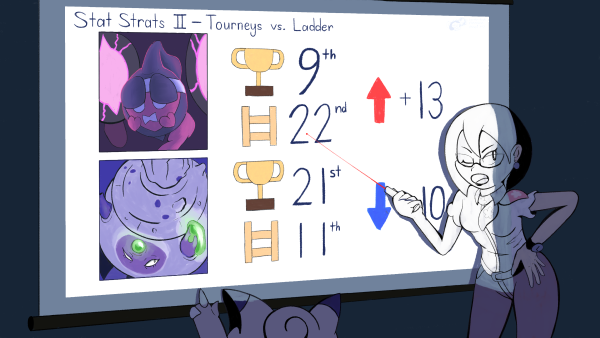
Art by a blue banana.
Introduction
Maybe you've seen the Policy Review conversations about tournament qualifications for suspect tests, the fights to the death in metagame and suspect discussion threads, Discord servers both private and public, or your favorite Pokémon Showdown! chat discussing whether or not the ladder even matters for metagame development. Maybe you just like statistics, OU, or both.
Three years and some change ago, I wrote an article comparing SV's tournament metagame to its ladder equivalent. SV was still but a baby, having cleared out most of the immediately overpowering creations but yet to receive its defining DLCs and Pokémon Home connectivity. Pokémon like Garganacl and Roaring Moon featured near the top of both lists, while others like Amoonguss and Hisuian Zoroark made the top 15 in only one of the two modes of play.
As we hunker down for another year or more of SV, surely, with all this time behind us, the metagame should have approached a Platonic ideal, a Nash equilibrium that cycles through metagame trends on a loop (at least, before the Tera Blast ban). On the other hand, given the differences between ladder and tournament play discussed in the previous Stat Strats article, you could understand why folks would be adamant that the metagames are so different as to be incomparable.
Disclaimers
Data doesn't tell stories; people tell stories. Objective numbers are twisted to subjective means. Even the choice of data is itself subjective, determining scope can entirely change a narrative before a single number is looked at. For the purposes of this article, I selected OST's Round 5 (top 64) and onward, as well as the full SPL season of SV OU, to compare against the month of March from the unweighted ladder, with credit to Marty. Given the lack of major metagame changes (Tera Blast was unbanned after all of these), I felt capable of widening the net further than I had in 2023.
I disregarded any Pokémon that did not place in the top 25 slots on either ladder. Maybe there's a story to be told about the tournament scene's 40th-place darling, Skarmory, falling to a distant 75th on the ladder, or how the ladder's 80th place Hisuian Zoroark went totally unused in the tournament dataset, but I'm not going to be telling that story.
Different or multiple months for the ladder dataset, different tournaments or narrower bands of OST rounds, or a different format entirely (there's probably a story to be told somewhere about the ADV or RBY ladders compared to their high-level tournaments) could've told different stories. The same goes for focusing on different parts of the data, such as teammates or move usage.
There is also a huge gulf in the raw counts of usage. I am actively using percentages to smooth over that difference because it is several orders of magnitude. The 25th-most-used ladder Pokémon was used nearly 5,000 times more often than all Pokémon in the tournament dataset combined. This is natural due to how much easier it is to play a ladder game than an OST or SPL game, but please just internalize that when looking at the numbers, understand that a single tour game contributes much more statistically than a single ladder game. Additionally, I am using the unweighted ladder to mirror the first Stat Strats article and to show the difference between what any player can experience and what is played at the highest level.
Hatterene and Landorus-T placed nearly identically (12th in tours versus 13th on the ladder for Hatterene, and 18th on both for Landorus-T) but have nearly 5% and 3% drops in usage, respectively, from ladder to tournaments. Cinderace has nearly the same usage percentage in both, 9.73% on the ladder and 9.52% in tournaments, but places six spots higher in the former's ranking than it does in the latter's. The scale when comparing here is important to keep in mind. Perhaps there are other stories to tell when looking at percentages, but I wish to echo the structure of the previous article – another subjective decision representing objective data.
Even in the data I did use for this project, I chose actively to focus on the differences rather than the similarities. While I will be listing a lot of Pokémon some of these differences are not exactly major game changers, and different words could just as easily have made these stats represent a single homogenous metagame between both modes of play. Great Tusk gets mentioned once, Gholdengo doesn't get touched on at all, and neither do Gliscor nor Ogerpon-W. Another story to be told of the similarities, for certain, but not one to be told here today.
If you take anything from this article beyond funny Pokémon numbers, please internalize – data doesn't tell stories, people tell stories.
| Ladder Top 25 | Tours Top 25 |
|---|---|
| Great Tusk 29.04% | Dragonite 35.27% |
| Kingambit 19.29% | Great Tusk 33.63% |
| Gholdengo 18.87% | Zamazenta-* 30.36% |
| Dragonite 15.67% | Gholdengo 29.91% |
| Dragapult 14.83% | Kingambit 27.38% |
| Iron Valiant 13.82% | Kyurem 24.70% |
| Ogerpon-Wellspring 12.58% | Ting-Lu 24.26% |
| Corviknight 12.55% | Pecharunt 19.35% |
| Gliscor 12.24% | Ogerpon-Wellspring 19.05% |
| Raging Bolt 12.08% | Iron Valiant 17.56% |
| Slowking-Galar 11.11% | Gliscor 16.22% |
| Zamazenta 11.03% | Hatterene 15.18% |
| Hatterene 10.56% | Darkrai 14.58% |
| Cinderace 9.73% | Corviknight 12.20% |
| Samurott-Hisui 9.12% | Samurott-Hisui 11.90% |
| Ceruledge 9.02% | Iron Treads 11.90% |
| Glimmora 9.01% | Dragapult 11.76% |
| Landorus-Therian 8.55% | Landorus-Therian 11.61% |
| Kyurem 8.46% | Raging Bolt 11.01% |
| Alomomola 8.42% | Deoxys-Speed 10.86% |
| Iron Treads 8.18% | Slowking-Galar 10.71% |
| Pecharunt 8.09% | Cinderace 9.52% |
| Rillaboom 7.81% | Walking Wake 9.23% |
| Darkrai 7.54% | Glimmora 9.23% |
| Ting-Lu 7.37% | Clefable 7.14% |
The Ladder's Darlings
On the ladder, your sets need to work game in, game out, for potentially dozens of games at a time. At the top of the ladder, you can expect opponents to be operating within a smaller range of viable options (nobody is building Last Resort Dragapult, for example), but your team needs to be able to withstand the constant beatings that RNG, Tera, soul reads, misclicks, and more provide. While not every level of the ladder is the same, over the course of a month, the ladder as a whole elevates certain Pokémon above others, Pokémon that the tournament scene may not be so on board with.
Kingambit is probably one of the faces of SV OU, having been here from the start and never fading from relevancy. Holding a solid 2nd place on the ladder, it falls somewhat from grace to a more muted 5th place in tournaments. By no means a bad showing, but a dip nonetheless. Kingambit is another good example of the sheer difference in scale, as, in raw percentages, 27.38% in tournaments is actually quite a bit higher than its 19.29% on the ladder, despite being three slots lower (though in 1695 stats, it hits roughly 25% on the ladder). Another slight drop is Iron Valiant, the Swiss Army knife of Pokémon, perhaps more flexible on a ladder where it's harder to predict sets, placing 6th there but only 10th in tournaments.
However, several more Pokémon have some serious falls from grace when trying to transfer ladder success to tournament play. Dragapult, a respectable 5th-place finisher on the ladder, finds itself languishing at a pitiful 17th place in tournaments, unable to transfer power and set variety from ladder to tournament play. Corviknight and Galarian Slowking, defensive stalwarts of the ladder (8th and 11th, respectively) capable of filling a small handful of important roles, frequently find themselves left behind in a more fast-paced tournament metagame, landing at 14th and 21st, respectively.
In a similar way, more effective but niche choices built for specific team roles, Raging Bolt and Glimmora, go from 10th and 17th on the ladder to a much less motivating 19th and 23rd – not quite as major a fall for Glimmora (who actually has a higher %, a story for another time), but another example of being unable to transition from ladder success to tournament consistency. These Pokémon do not share a common thread or design philosophy, instead spanning a wide range of set depth and team roles.
Tournament Heroes
In a tournament setting, you're playing one to three games a week, with some amount of opponent research and scouting supporting a custom-built team for that specific match. A move or item selection only needs to pay off once to be successful, and a unique bring doesn't need to face the constant beatings of the entire ladder metagame to prove its worth; it only needs to face the six Pokémon your opponent brought for that specific round.
While not the largest difference between tournaments and the ladder, Dragonite holds a unique position as top dog in tournaments, with the ladder's #1 Great Tusk placing a respectable 2nd in tournaments. Dragonite, however, drops to the non-podium placement of 4th when moving to the ladder, a major dip in usage given its pedigree. With Tera Blast still very much legal for the entire timeframe of the dataset, it perhaps clarifies the sudden shift of Tera Blast from "not a lot of interest" on surveys to the move's banishment to Ubers via a suspect test, a very unique occurrence.
As mentioned in the previous paragraph, Dragonite did not have the largest drop, and in fact, every other listed Pokémon has a much larger drop from tournament play to the ladder. The smallest drop is Iron Treads, moving down six places from 15th in tournaments to 21st on the ladder (an even smaller drop with 1695 stats, where it places 18th). Darkrai moves from 13th to 24th, a drop larger than all but Dragapult's in the other section.
That's only scratching the surface, however, as a duo of defensive behemoths, perhaps somewhat replacing the presence of Corviknight and Galarian Slowking on the ladder side, find themselves much more successful in tournaments compared to the ladder. Pecharunt drops an astonishing 14 slots from 8th to 22nd, while Ting-Lu fares even worse, going from 7th to 25th, barely making it into the list in the first place.
Kyurem, not quite as defensive as the other two but certainly no stranger to more protracted gameplay, suffers a similar fate; a respectable 6th place in tournaments not at all reflected by its ladder placement of 19th. (Though, if you look specifically at the high ladder, Kyurem rose to 9th!) Zamazenta is similar, if not perhaps worse, going from a podium 3rd-place finish in tournaments to an extraordinary 12th place on the ladder, a major drop for the two game mascots (sorta) that make their presence known in OU.
Solo Flyers
Unsurprisingly, at the "lower" sections (a reminder, we're still talking about the top 25 most-used Pokémon in either dataset; the quotation marks are doing a lot of work here!) of the data, there is more divergence due to variance. While we've yet to touch on them, six Pokémon exist only in the top 25 on one side of the coin, dipping below the magical and arbitrary demarcation for this project.
Some of these are somewhat understandable, such as Walking Wake landing 23rd in tournaments but 27th on the ladder, but others are more distant, with the ladder loving Ceruledge enough for 16th place but mostly shunning it in tournaments, where it lands a distant 34th.
Clefable, for example, has a ten-spot difference, barely squeezing into the tournament list at 25th but reaching a respectable yet unlisted 35th on the ladder. Deoxys-S, on the other hand, has the 20th spot in tournaments but a more distant 32nd place on the ladder, perhaps a good example of a Pokémon that only needs to accomplish its task once to be successful in a tournament game compared to the forever grind that is ladder success.
Finally, the last two Pokémon are utility-focused teammates that find success in the repetition of the ladder but maybe struggle to translate that success into tournaments. Alomomola and Rillaboom rank 20th and 23rd on the ladder, respectively, but fall to 32nd and 38th in tournament play, their consistent yet limited supportive offerings seemingly less in demand in the single-match gameplay that comes out of SPL and OST compared to the endless task that is ladder success.
Conclusion
There's almost certainly a fractal's worth of discussions and arguments that could be had off of just this one small snapshot of OU metagame development. Smogon Tour and World Cup of Pokémon have since finished over the course of writing this article, the Official Ladder Tournament is not terribly far away, and shortly after that will come the Smogon Champions League and even more OU gameplay. Pokémon are being considered for a return due to the Tera Blast Ban, Regieleki is waiting to see if it'll fall below RU, and even more changes may be on the way in future tests and metagame developments.
OU, and competitive Pokémon as a whole, is what you make of it, and these statistics are no different. Do Dragapult and Ting-Lu convince you that the two modes of play are indescribably different? By all means, see it that way! Does the lack of discussion on metagame staples like Great Tusk, Gholdengo, Gliscor, Ogerpon-W, and more convince you that, while the margins may be slightly different, the core of the two modes are the same? Just as correct an answer as the other angle.
What both perspectives can probably agree on is that SV, despite approaching its senior year as a current metagame, still has much room for learning, development, and interpretation. A stable metagame may settle into a final place, viability-wise, or it may cycle between different Pokémon being 'in' or 'out'. We've just banned Tera Blast, and it's impossible to know what will come of that after a long time during which the banlist stayed mostly identical. Even just in the process of writing this article, we've seen a Volcarona unban test and tier adjustments such as the rise of Cresselia.
What you take away from this article is an exercise for the reader. SV is with us into the future as an OU metagame approaching what will become its final state, but it will remain the current generation with active tiering for a while yet. What the final story of SV will be, I think, nobody can say, but ladder and tournament play will continue to develop the metagame in their own ways for their own circumstances well into the future. Whether you see these stats as signs of indisputable differences (remember, I focused on what was different more than what was the same) or of a metagame converging toward, or having already arrived at, a nearly identical state between modes of play, SV OU and its quirks will be with us into the future, and these stats perhaps show us both the differences and the similarities between the two modes of play.
| « Previous Article | Next Article » |