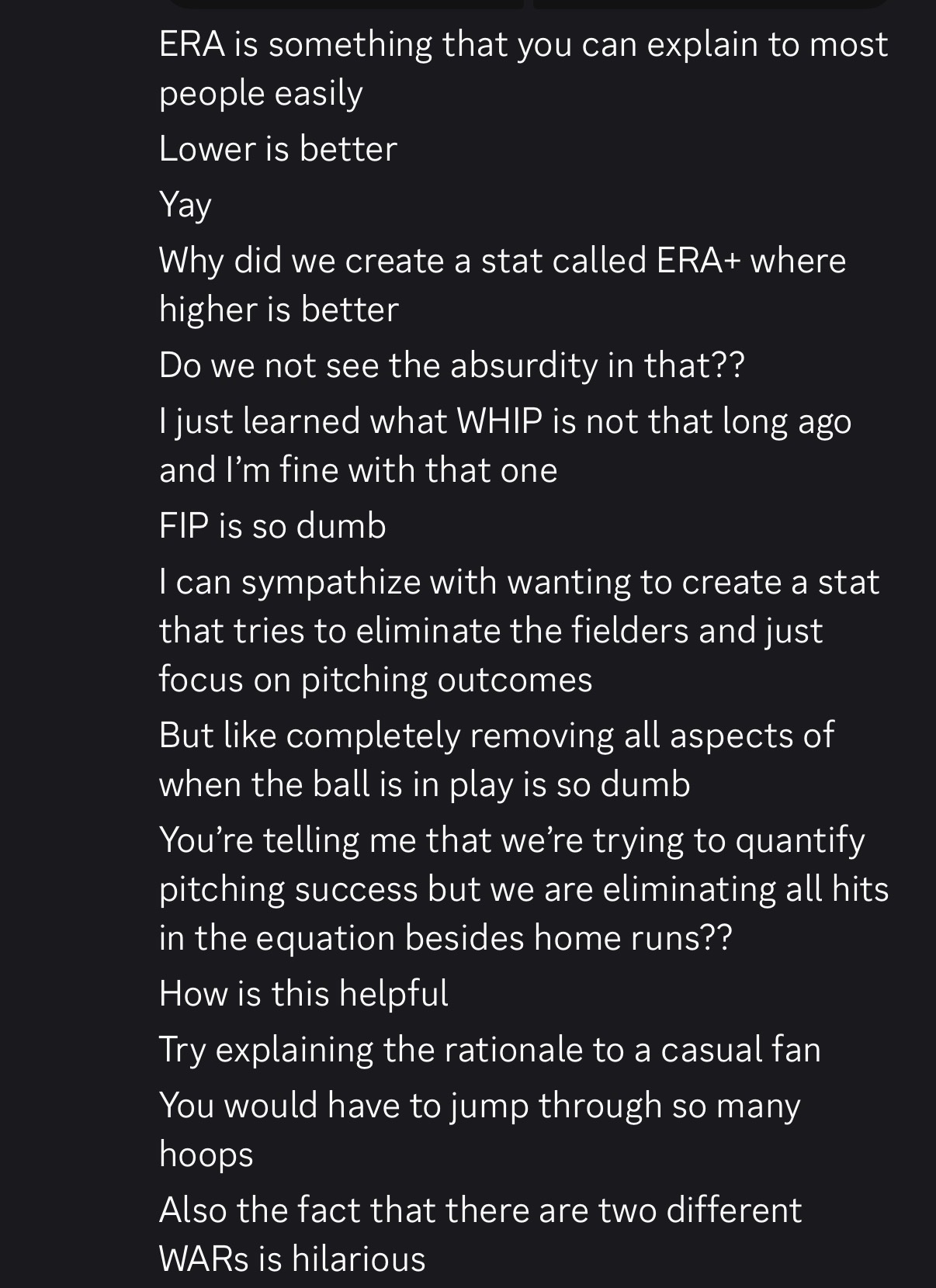
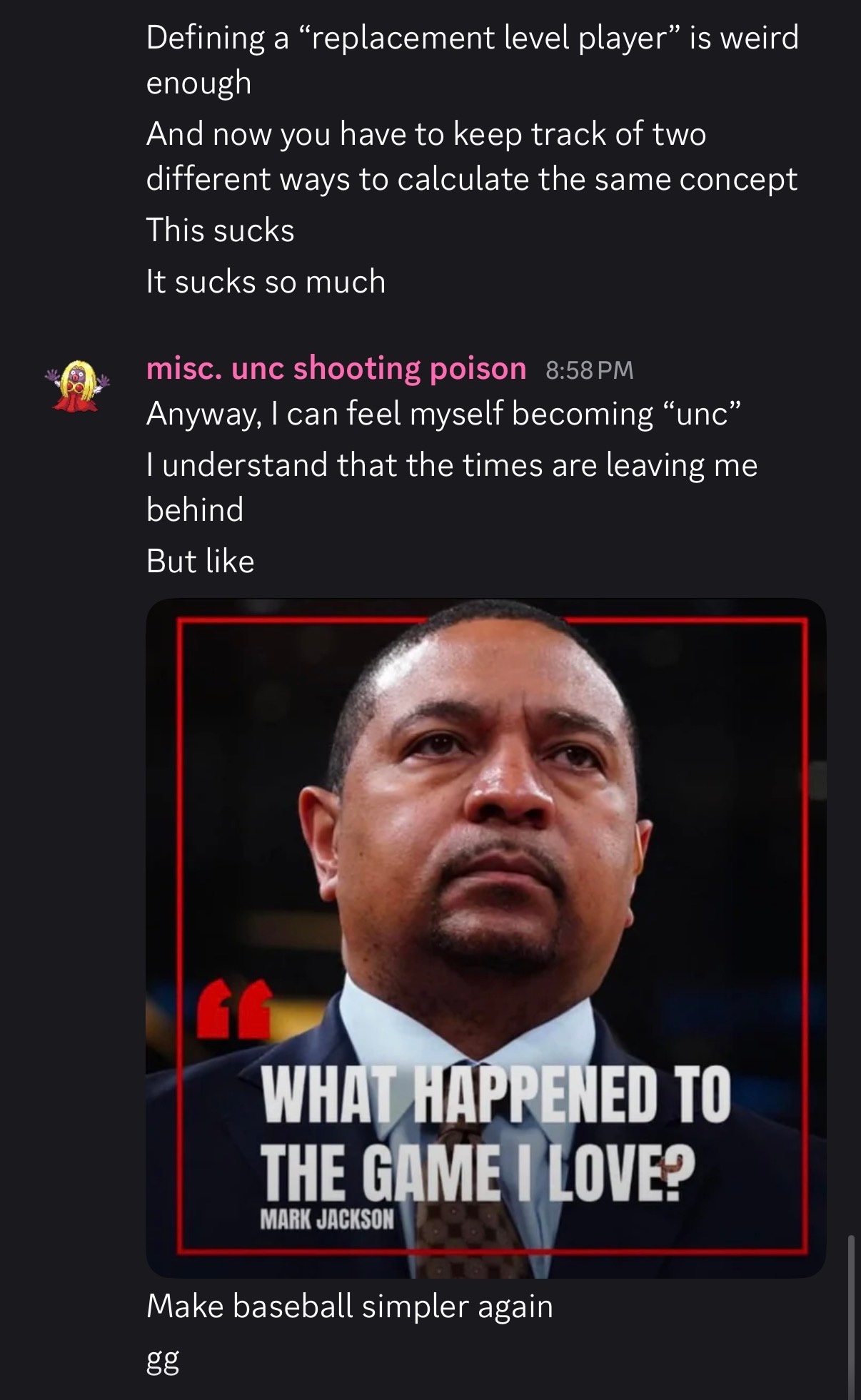
As I've been increasingly getting into baseball, I've been increasingly getting into advanced baseball statistics, so it's nice to have a place to talk about that!
My Brewers doing well has certainly helped, but another big factor in my interest is the advanced stats of baseball, and the informed commentary that tends to accompany them. A lot of eg football discussion feels very sloppy, where few people know ball, and fewer than that know how to explain it. Baseball's more formal tradition, in my experience, has led to a lot higher quality discussion and engagement.
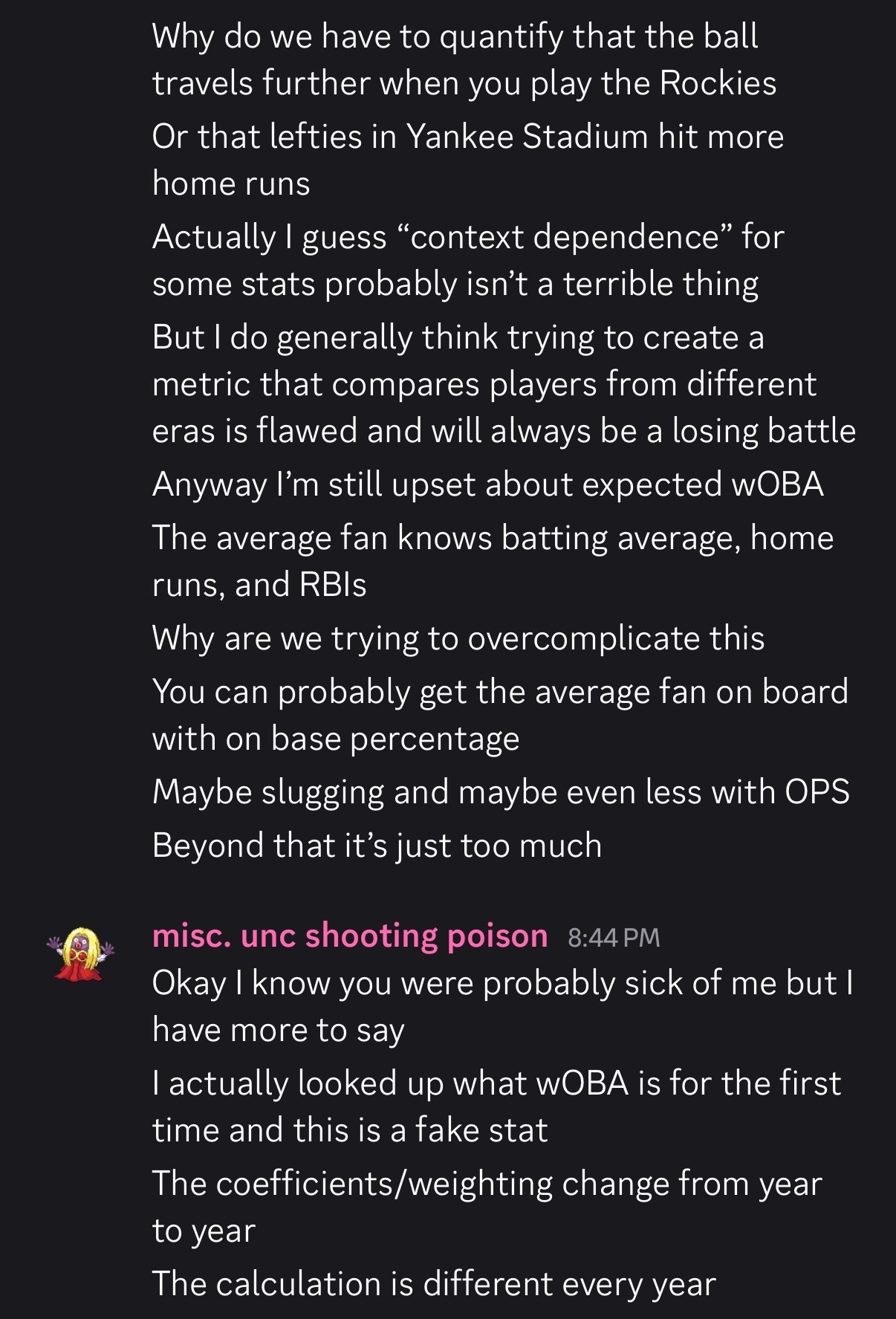
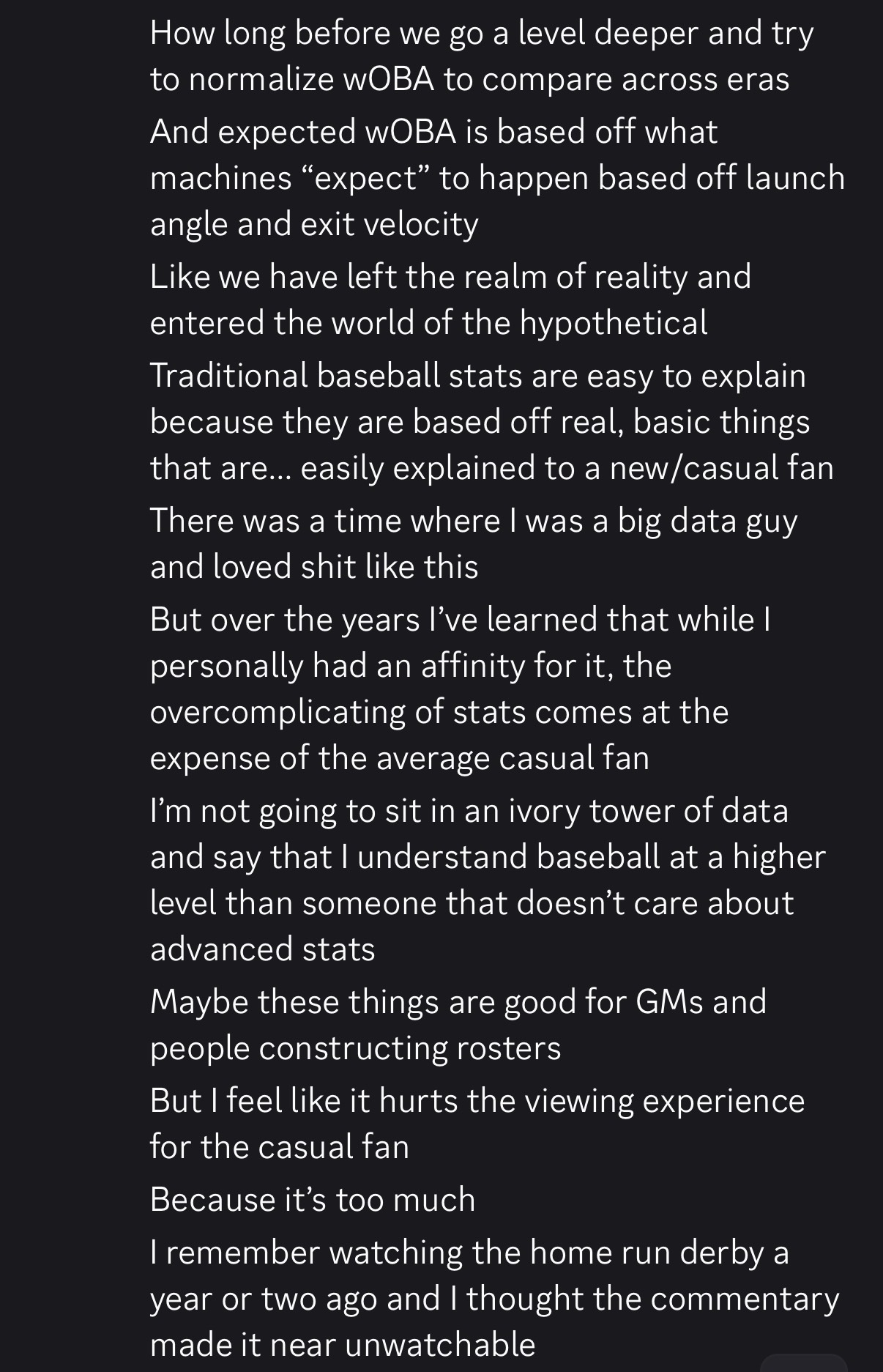
...all that being said, I more disagree with your rant than agree with it ;). But not fully! I'll divide my thoughts here in two.
1) Are analytics taking over?
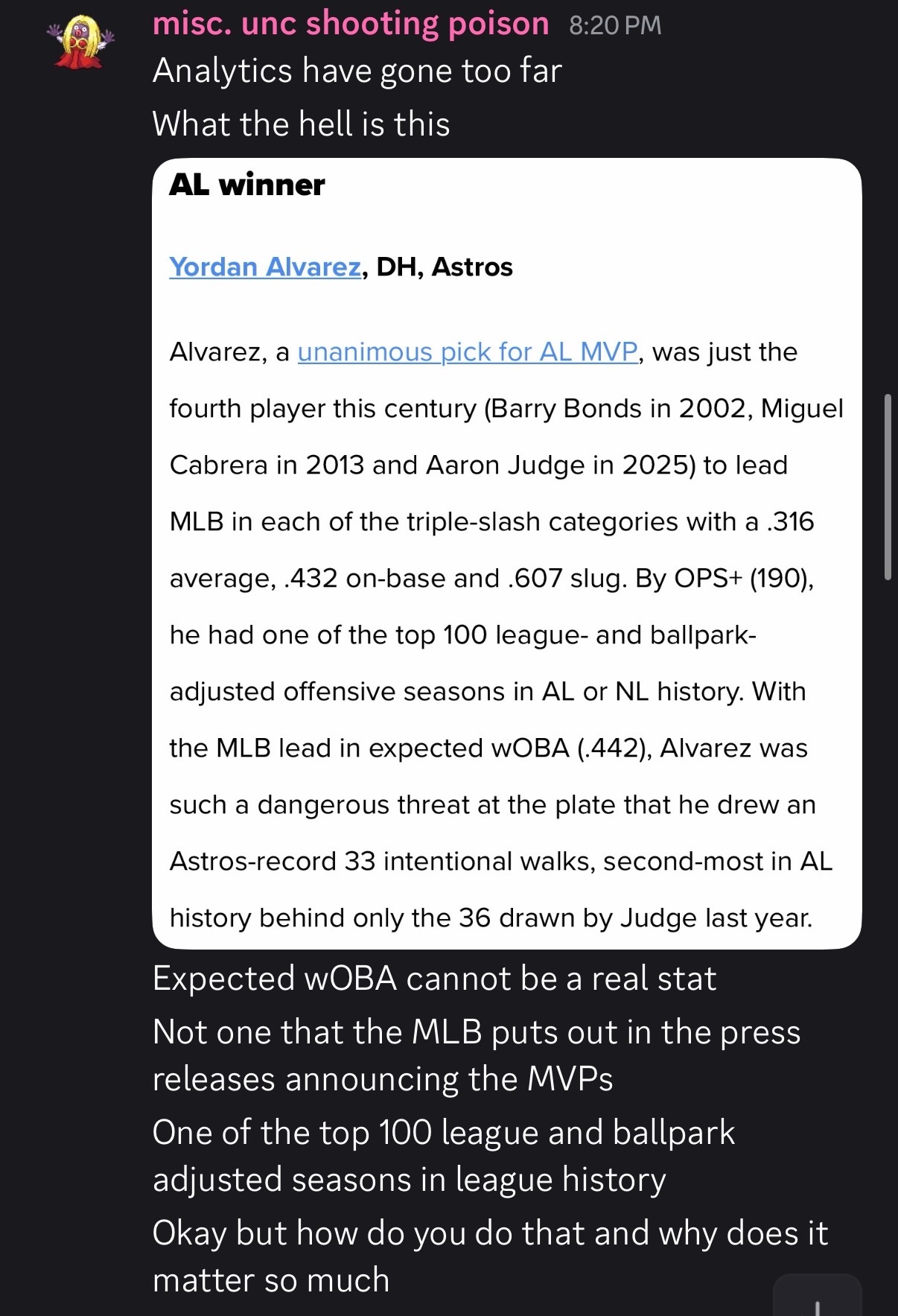
I don't think so. The article mentions some medium-grade stats, but the way it does so is casual-accessible and limited. This "bounded presence" is how I think about the presence of analytics in modern baseball in general, so I'll talk about the article snippet more as synecdoche for my stance at large.
First, the article leads with more familiar stats. If all you care about is the slash line, Alvarez led the entire league with it! Woah! He led in BA, the traditional "Stats nerds HATE this one trick to discourse relevance!" category. I'm surprised there's no mention of home runs, but if all you know is slug = hit farther, you can tell this guy is a home run threat.
It mentions OPS, and many people won't have a reference frame for 190 OPS+, sure. But they don't need to if they want to get the sentence's point: he had one of the 100 best batting seasons, adjusted for contextual factors (according to some numbers people). You don't need to know stats to know that's a big deal. Similarly, they mention wOBA, but they demonstrate the wOBA "threat at the plate" point with a very accessible reference point of intentional walks - second most in AL history! Overall, even if the only stat you know is BA, this article gives you the context for the meat to make sense, and the stats you can ignore if you want.
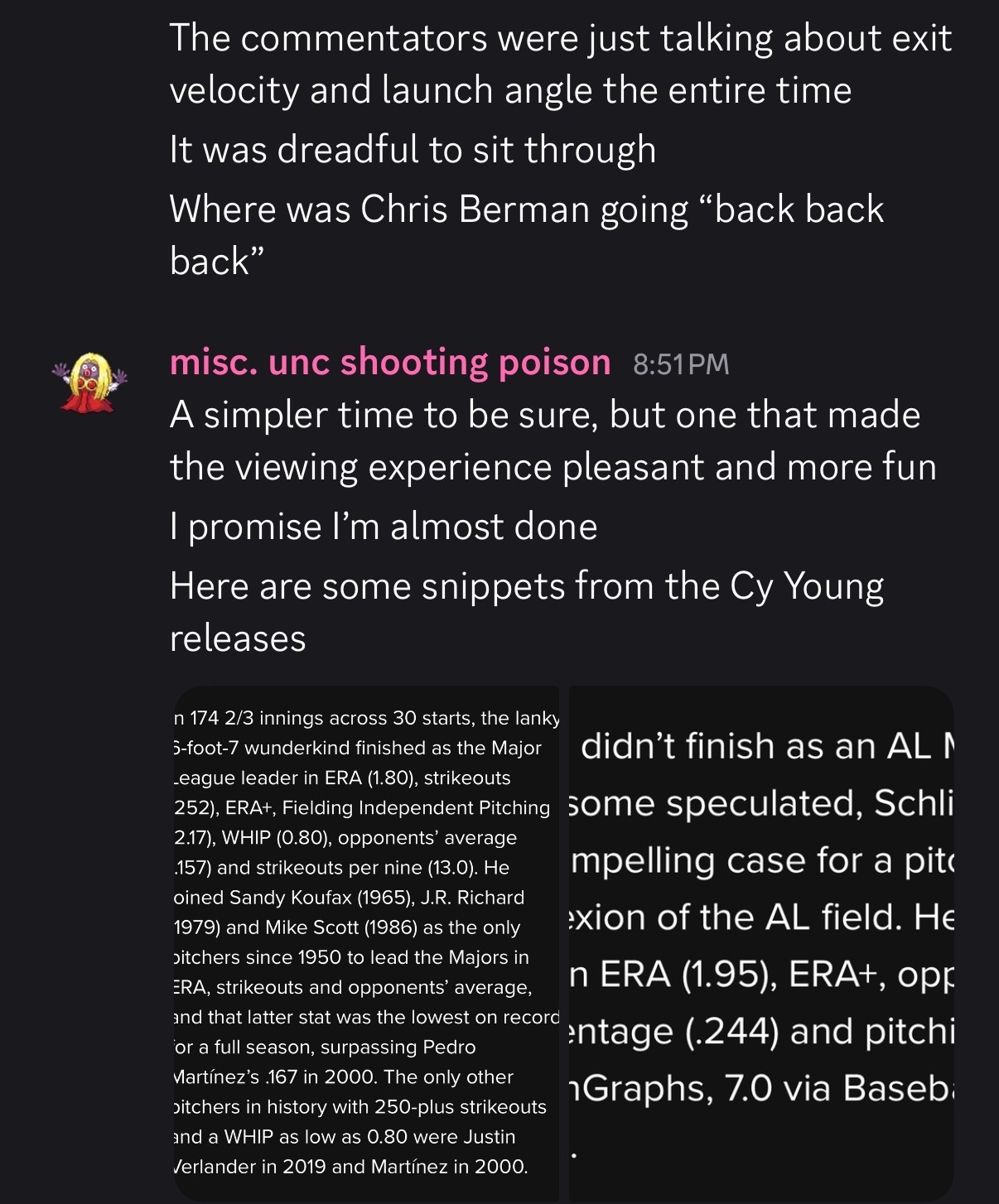
Beyond the article, I don't think these stats are as advanced as you imply. You point out that ERA is easy to understand because all you need is lower = better pitcher, and I agree! Similarly, slug is "higher = power hitter", and wOBA is "higher = better hitter."
In short, I'm not sure what the harm to casual fans is here. They get most of the picture, and at some point, getting a fuller picture will require learning more than a handful of numbers. If they do want that fuller picture, they're welcome to learn more, as easily as googling "wOBA." I did so, and got this resource from FanGraphs, with this accessible snippet in the top.
wOBA is based on a simple concept: Not all hits are created equal. Batting average assumes that they are. On-base percentage does too, but does one better by including other ways of reaching base such as walking or being hit by a pitch. Slugging percentage weights hits, but not accurately (Is a double worth twice as much as a single?
In short, no) and again ignores other ways of reaching base.
Some other notes:
Sal Stewart did just win NL ROTY - the most contested award this cycle. The sabermetric bogeyman of RBI was a big part of his case, and the analytics community
clearly wanted him to lose, especially to JJ Wetherholt. I've seen Sal as low as tenth.
As I alluded to earlier, baseball's statistical importance is a big part of what makes baseball, well, baseball for me. Of course, that won't be for everyone. But baseball's unique statistical tradition is decades in the making, and is part of what makes it unique versus other sports. Even if people don't get all the acronyms right, they can take pride in people putting a lot of care and effort into understanding their sport, care that feeds into baseball's unique understandings of what makes players better.
Statistical depth and simpler baseball sometimes go hand in hand. Playing defense intuitively matters, for all the problems of DRS and FRV and whatever, the basic stat suite just does not value defense. One of the most emphatic claims of sabermetrics is that home runs matter a
lot, even more than people thought, and that hitting dingers is worth striking out a lot. Makes sense! People have overestimated the importance of successful ABS challenge
percentage, and underestimated the importance of raw ABS successful overturn count. Part of why my Brewers play a more BA style of offense is grounded in the stat of RISP. We hit very well when runners are in scoring position, so it makes sense to put runners in scoring position!
The teams lauded as the most analytical tend not to be the best and win the most. The Rays-Brewers World Series seems like an exception, and in
some ways it is, but the Brewers are not as statistical as people may think. Big parts of their success are non-statistical, like their very analog manager of the year, and their winning team culture. Their
smoking habit is a statistical gem, on the ironclad logic of "if they smoke heaters before the game, they'll smoke heaters in it." Other success is still cerebral, but more strategic than numerical, like their strategy of trading away stars before their contracts expire to hoard prospects, and of targeting non-pull hitting as a relatively undervalued (and underpaid) skill. They certainly don't shy away from statistical analysis, but they're willing to avoid overthinking it – like not obsessing about platoon handedness and splits in ways that risk lowering their overall production. They also get huge mileage from proprietary predictive analysis that doesn't enter
any fan's world.
2) What is and isn't the value of analytics?
I'll get an easy one out of the way. I have no leverage or opinion on judging players across eras. I have no particular support for stats there.
Some of the things you say don't matte a tonr, I agree. Sometimes it's just trivia fodder or commentator fodder. There are surely commentators and trivia that can do better.
For wOBA being a fake stat or not, my biggest disagreement is the isolated treatment of it. wOBA is part of a toolbox, and our decision isn't just "Is wOBA real enough?", but "Is our analysis more real when we remove wOBA?"
Like, if we're not using wOBA to calculate "batting average adjusted for quality of hit," we're using slugging, right? And I would say the 1-2-3-4 weighting of singles, doubles, triples, and home runs is very fake. The exclusion of walks may be too. There's an appealing simplicity to slugging, but who says a home run is exactly 4 times as valuable as a single, and why? I'll be honest - I don't care about the intricacies of wOBA, so I'm not going to defend its particular weighting dynamics. But for being
less fake than slugging, the bar is very low, and we're down with slugging.
To your point of reality and hypotheticals and machine expectations... again, the problem for me is that reality is often a fake-ass analytical tool! If three teammates ahead of you hit singles to lead the bases, and you hit a double where the man on 1st takes the extra, the idea that you 'gained' 3 runs batted in is fake as hell. You just hit a double! And were lucky your mates got on base and ran well!
My big picture case for advanced stats is they help us see past the fakeness of reality. Sometimes a player gets a very good batting average, especially in a limited sample, but they just happened, by no particular talent, to hit bloops and line drives between the infielders a ton. That kind of luck can't keep going on forever, so an advanced stat like xwOBA (or BABIP, or even xBA) helps us see through that unsustainable mirage.
And with that goal of clarity, a good analyst has to acknowledge the limits of statistics. A big-time sabermetrician, Dan Szymborski, wrote a very interesting
article on why his big modeling system repeatedly underestimated my Brewers. In short, his system did a good job at charting out the likely best-case and worst-case scenarios for each player, but the Brewers' internal development and statistics team is very good at identifying
which players will reach the best-case scenario, and giving them a lot of playing time.
To be clear, this underestimation is no unique fault of advanced statistics. Casual commentators underestimate the Brewers, and usually more so. But that's another thing about advanced statistics I appreciate – they give us a base to learn from, with people who want to learn. When statistics perform worse in analysis than we think, we can ask why – many advanced statistics were born from curious questions like that. Every stat is flawed, but if we dig into those flaws to find deeper material, we can build a toolbox (of which advanced stats are
one part) that collectively gives us more insight, and ability to make predictions and answer questions.
I am not going to sit in an ivory tower and say I understand baseball better than everyone else. I have not played baseball. I do not know what it's like on your body to dive for a catch. I don't know how it feels to hit a home run. And there's tons of intuition and built-up little things I lack from just having less experience and time playing and watching. That's fine.
But just like how some fans know those things better than me, I know some things better than other fans. Other fans ask "How do the Brewers pitch so well and hit so well in the clutch, especially with unheralded players?" Statistics are not my whole answer, but they help me. Sometimes they help me in a direct way - we may acquire players from other teams with mediocre basic stats but better advanced stats, for example.
Even more often, they help me indirectly. I know that the Brewers have a consistently higher than average RISP (batting average with runners in scoring position), which is one thing, but then I also asked
why they were uniquely talented here, and researched and thought about it, and found some answers that help me and casual fans understand. (We try and steal a lot, which distracts and puts pressure on other pitchers. We have hustle and make good contact, creating many situations where opposing defenses
can get us out, but they have to make harder plays, and they suffer more from suboptimal plays, improving our odds.)
This ability to not just know some advanced statistics, but put them into context, evaluate them, understand them beyond the literal sticker, is key for being a good analyst to me. Advanced stats are not a magic bullet to questions, but a continual platform to learn more and more.
And my use of
some there was operative. I do not know the difference between fWAR and bWAR, or (beyond the surface level) OAA and FRV, but I don't care to and I don't need to! There is no perfect statistic, so I - and casuals - can just stick with the imperfect WAR statistic, which is mostly as good. Or they can stick with whatever, and any other term used in a casual analysis should be contextualized for them, like in the snippet you showed, or explainable with a sentence or two.