
-
Follow our Instagram!
-
Curious about what we're currently doing about bots? Check out the latest updates from staff in this thread.
-
Welcome to Smogon! Take a moment to read the Introduction to Smogon for a run-down on everything Smogon, and make sure you take some time to read the global rules.
You are using an out of date browser. It may not display this or other websites correctly.
You should upgrade or use an alternative browser.
You should upgrade or use an alternative browser.
Memes You Found Mk. 2
- Thread starter phoopes
- Start date

I decided for the first time ever to post a meme that i found instead if one I made.



English language is weird
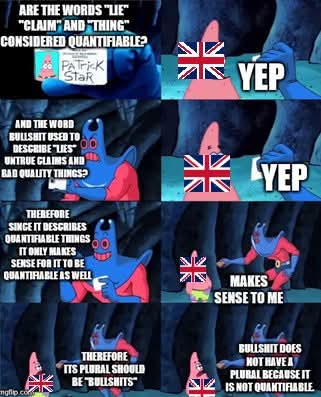


It's complicated 
"Describes quantifiable things" gets at the problem. Bullshit is a descriptor. It can straight-up be an adjective – you can call something bullshit – but even when bullshit is a noun, it exists to both communicate a noun and an adjective. You can pretend the noun bullshit is short for "bullshit claim," where bullshit is the adjective again, and claim is the noun. The "claim" noun is unsaid in the phrase bullshit (noun), but it's implied, and that implication helps us be less wordy.
Therefore, bullshit does not mean "a group of multiple lies," or more generally "a group of quantifiable things" in the same way that a flock of multiple birds does. And indeed flocks works as a plural. Remembering bullshit's adjectival role, the lack of a plural makes more sense. You wouldn't say "beautifuls" to describe multiple things that are beautiful – conventionally anyway, don't let me stop you, I'm a descriptivist – you'd say "beautiful things." For bullshit (noun), it's the same principle, but we just undo the phrase shortening and unpack bullshit into its full and explicit form, "bullshit thing." Then we add the plural onto thing, like with beautiful.
So we have a reason why bullshit lacks a conventional plural. But could that reason itself still be arbitrary? Well... probably still, yeah. We're drifting closer to language nerdery, when my domain is the similar but not-quite-identical communication nerdery, so I would not say I have all the answers. English handles "adjectivey nouns" in a lot of different ways, and I'm just not completely aware how much of those differences are "for reasons" versus "for reasons, with exceptions" versus "for delicate fine-grained reasons that are subtle enough to often function as vibes in practice" versus "for vibes, straight up."
I started mucking around for a more detailed answer and found the muck-to-insight ratio was not great, so I'll leave it at this.
Plurals of adjective-nouns vary widely in acceptedness and usage.
Some adjective-nouns straight up have plurals. Reds is definitely a word. But it's generally constrained to specific situations – specific shades of color come to mind, as do red wines, and a proper noun for a baseball team. Using reds more generally, like to describe multiple miscellaneous red objects, would get you a similar type of confusion to bullshits.
Some adjective-nouns have slightly modified noun forms, like accurate versus accuracy. These nouns may have straightforward plurals, like "accuracies", which often fit into a mold of "not seen as wrong, but awkward in practice, in part because of limited use cases." Beautiful becomes beauty as a noun, and "beauties" is definitely a word, but specifically for a group of people, not other contexts, and can come across as demeaning if used carelessly.
Sometimes these plural nouns are more straight up not used. Literate becomes literacy, but people don't say literacies, they say literacy rates.
Some have more intense modification. Peanut butter and jelly is a compound adjective that usually only makes sense in the context of the noun peanut butter and jelly sandwich, which is often modified in practice to the PB&J abbreviation, and PB&Js works as a plural form, but again the use cases are a bit niche.
I love word nerdery


adjective-nouns
I didn't know that we could post webcomic strips here.


i probably would have just deleted this one but
the unintended read of zangoose having internalized homophobia makes it hit i think
Sorry, I deleted it.i probably would have just deleted this one but
View attachment 837122
the unintended read of zangoose having internalized homophobia makes it hit i think
Here is an other one.

I have no idea what the context for this is, but frankly, I'm loving the confusion way more than I would enjoy it if I understoodSorry, I deleted it.
Here is an other one.View attachment 837267
this game had a great premise, I really wanted to love it but it is suffering from Japanese Writting Syndrome (artificially extending the duration of the story for no reason).

Last edited:


